
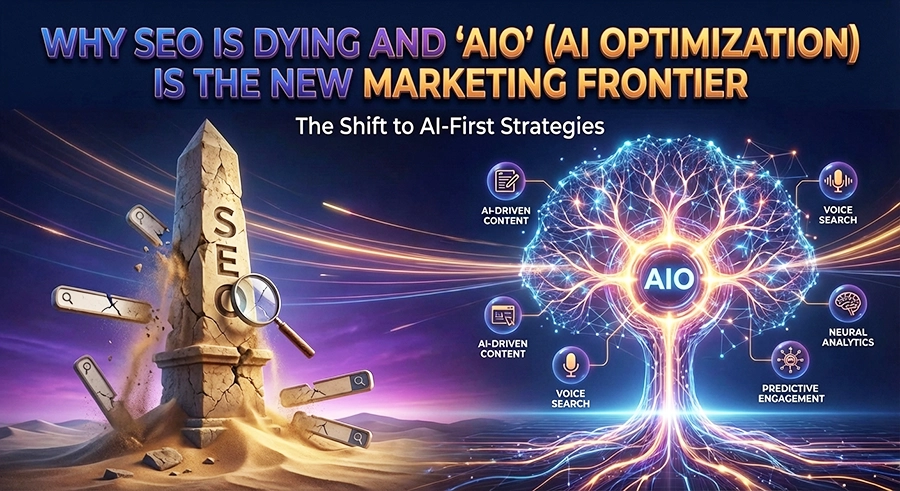
Why SEO is Dying and 'AIO' (AI Optimization) is the New Marketing Frontier
Listen: Why SEO is Dying and 'AIO' (AI Optimization) is the New Marketing Frontier

Google's blue links are no longer the only door into your product. AI Overviews, ChatGPT answers, Perplexity citations, and research engines increasingly answer first and send traffic second—if they send traffic at all.
That is why searches for AIO, AI Optimization, GEO, LLM SEO, and "how to get recommended by ChatGPT" keep rising. Classic keyword SEO still matters. It is no longer enough. If language models cannot confidently cite and recommend you, a #1 ranking becomes a shrinking prize.
This guide is a practical AIO playbook for SaaS, affiliates, agencies, and content-led brands: what AIO is, the pillars that win recommendations, the stacks that execute it, and how to measure mention share—not only rankings—using tools from Skowers.
SEO Is Not Dead. Unciteable SEO Is.
Traditional SEO optimized for crawlers and SERP slots. AIO optimizes for synthesis and recommendation.
SEO still wins when someone wants a list of options, a comparison page, or a long research tab-out. AIO wins when someone asks an assistant "what should I use for X?" and expects one or three clear answers with reasons.
The businesses that panic are treating AI search as a traffic apocalypse. The businesses that win treat it as a new distribution layer that rewards:
- Clear problem/solution language.
- Evidence and original data.
- Brand differentiation models can repeat.
- Fast paths from recommendation to trial.
What AIO (AI Optimization) Actually Is
AIO is the practice of making your brand easy for LLMs and AI search systems to understand, trust, cite, and recommend.
It is not stuffing "ChatGPT" into meta tags. It is building citability: content and product narratives so clear and authoritative that an answer engine feels safe using them.
Track both layers:
- Classic SEO: rankings, organic sessions, conversions.
- AIO: AI mention share, citation quality, referral quality after an AI mention, trial starts from AI-referred visits.
Use the Skowers Dashboard to track the SEO/AIO tool seats you trial so costs stay tied to outcomes.
Pillar 1: Citeable Authority (Knowledge Artifacts, Not Keyword Shells)
LLMs prefer sources that look like expertise: methods, numbers, definitions, comparisons, and primary data. Thin listicles with synonym soup get skipped.
Practical moves:
- Publish fewer, deeper pages that answer one question completely.
- Add original research, customer surveys, pricing benchmarks, or case studies with real metrics.
- Cite credible sources and make your unique claims easy to quote.
- Keep product docs and comparisons current so models do not invent outdated features.
Consensus shows the shape of citeable authority in research: peer-reviewed synthesis in a format humans and AI systems can trust. Your marketing content should chase the same property—verifiable, structured, useful—not vanity word counts.
BabyLoveGrowth helps teams operationalize this by planning ranking-focused content, publishing brand-aligned articles, building authority links, and tracking how often you show up in ChatGPT and other AI answers—classic SEO plus LLM visibility in one loop.
QuillBot is useful for clarity passes so dense expertise stays readable without becoming generic sludge. Write the expertise first; use polish tools second.
Authority checklist:
- One definitive page per core buying question.
- Proof (data, screenshots, methodology) on the page.
- Clear last-updated signals on living docs.
- No contradictory feature claims across marketing site and help center.
Pillar 2: Natural-Language Product Narratives
People type keywords into Google. They speak goals into AI.
"Project management software" becomes "something that helps my remote team stay coordinated without endless meetings."
Your site must answer, in language an LLM can repeat:
- What problem do you solve?
- For whom?
- How are you different?
- What happens in the first 10 minutes?
Audit method: paste your homepage and docs into a major assistant and ask, "Based only on this, who should use this product and why?" If the answer is vague, AIO will stay vague too.
Use comparison and category language honestly. Models recommend what they can contrast. Ambiguous positioning loses to a sharper rival.
Pillar 3: Conversion After Recommendation
In the AI era you often get one shot. When an assistant says "try Tool X," users expect value in minutes—not a gated PDF maze.
Make the path frictionless:
- Clear trial or free start.
- Fast activation to core value.
- Proof above the fold after they land.
- Pricing that does not require a salesperson for a simple decide.
Directories like Skowers that surface tools with real trials help match how AI-era buyers discover and evaluate software. When an AI points at you, your first screen must confirm the recommendation.
Pillar 4: Technical + Generative Visibility Ops
AIO still needs a healthy site. Broken crawl paths, thin duplicates, and messy internals hurt both Google and AI retrieval.
Alli AI automates on-site SEO execution—finding opportunities and implementing improvements without turning every change into a developer ticket.
OmniSEO is built for the visibility layer across ChatGPT, Perplexity, Google AI Overviews, and related AI search channels—so you can track brand presence beyond classic rank trackers.
Agencies packing SEO + content + distribution for many clients can look at AISQ as an operating system that keeps research, publishing, and reporting from becoming a duct-taped mess.
Ship and iterate marketing sites quickly with hosting like Netlify so AIO experiments (new comparison pages, FAQs, structured docs) do not wait on slow deploy cycles.
Pillar 5: Ecosystem Presence
Beyond your site:
- Maintain accurate profiles where models and humans research tools.
- Prefer structured, consistent product facts across listings.
- Earn mentions in cite-worthy roundups and expert content (not only low-quality spam directories).
- Consider native assistant integrations when your ICP lives inside those chat surfaces.
AIO is partly distribution hygiene: make the public record of your product coherent everywhere an LLM might look.
Three AIO Stacks You Can Run
Solo SaaS / founder stack
- BabyLoveGrowth for content + AI visibility tracking.
- Alli AI for on-site SEO execution.
- OmniSEO for multi-surface AI search monitoring.
- Dashboard for tool cost discipline.
Evidence / thought-leadership stack
- Research and citations with Consensus where claims need academic scaffolding.
- Deep pillar pages and clarity polish with QuillBot.
- Packaging research into decks or interactive guides with Gamma for partners and launch days.
- Fast site iteration on Netlify.
Agency / multi-client stack
- AISQ for coordinated SEO/content delivery.
- BabyLoveGrowth or Alli AI depending on client maturity.
- OmniSEO for AI-answer reporting in retainers.
- Shared proof libraries so every client page becomes more citeable, not more generic.
30-Day AIO Sprint
Week 1 — Baseline Prompt-test ChatGPT, Claude, Perplexity, and Google AI surfaces for your top five buying questions. Log who gets recommended and why. Audit your homepage narrative with the same questions.
Week 2 — Citeability upgrade Rewrite or build one definitive page per top buying question. Add proof, definitions, and clear differentiators. Fix contradictions between docs and marketing.
Week 3 — Execution systems Turn on Alli AI and/or BabyLoveGrowth workflows. Set OmniSEO (or equivalent) tracking for AI mention share. Publish one original-data asset (benchmark, survey, teardown).
Week 4 — Conversion + iteration Shorten time-to-value on trial. Add FAQ blocks that mirror natural-language prompts. Re-run the baseline prompts and document movement.
How to Measure AIO (Not Only SEO)
Track monthly:
- Classic organic sessions and assisted conversions.
- AI mention share on a fixed prompt set.
- Whether you are top recommendation, mid-pack, or absent.
- Referral quality from AI-linked visits (bounce, trial start, activation).
- Content that gets cited vs content that only ranks.
If rankings rise but AI mention share is flat, you optimized yesterday's channel only.
Common Mistakes That Waste AIO Budget
- Publishing 30 thin posts instead of five citeable ones.
- Feature lists with no buyer-context narrative.
- Gating everything so AI-referred users bounce.
- Chasing one model while ignoring others.
- Buying "AI SEO" tools with no measurement of mention share.
- Ignoring Google entirely—classic SEO still feeds much of the web corpus models rely on.
SEO vs AIO: The Working Model for 2026
Keep SEO for demand capture and compounding technical health. Add AIO for recommendation share inside answer engines. The winners do both: crawlable excellence plus language and proof models can trust.
The era of "rank #1 and win by default" is fading. The era of "be the recommendation an AI can defend" is here.
Next Step
Pick one bottleneck this month.
If you need content + LLM visibility on autopilot, start with BabyLoveGrowth. If on-site SEO execution is the gap, start with Alli AI. If you need AI-search monitoring across ChatGPT/Perplexity/AI Overviews, start with OmniSEO. If you run client retainers, evaluate AISQ. If research-backed authority is the moat, use Consensus as a workflow for evidence.
Browse more SEO and growth tools in the Skowers directory, trial against a named AIO job, and keep only what moves rankings or recommendation share.

Related Articles

Continue Your Research