Creativity Jan 24, 2025 12 min read
The Unexpected AI Roles Revolutionizing Creative Industries
The creative industries are in the middle of a quiet rewrite. AI is no longer a novelty or a side experiment in the corner of a studio. It has become a production partner, a brainstorming engine, and in many cases, the invisible infrastructure that makes modern creative work scalable. The biggest surprise is not that AI can generate images or write a melody. The surprise is how many roles AI is taking on across the full creative lifecycle: research, ideation, pre-visualization, production, post, distribution, and even monetization.
This is a full tour of the most important AI roles reshaping creative work right now, and how each one is changing the economics and the craft of creative industries.
Generative Art: From Novelty to Studio Standard
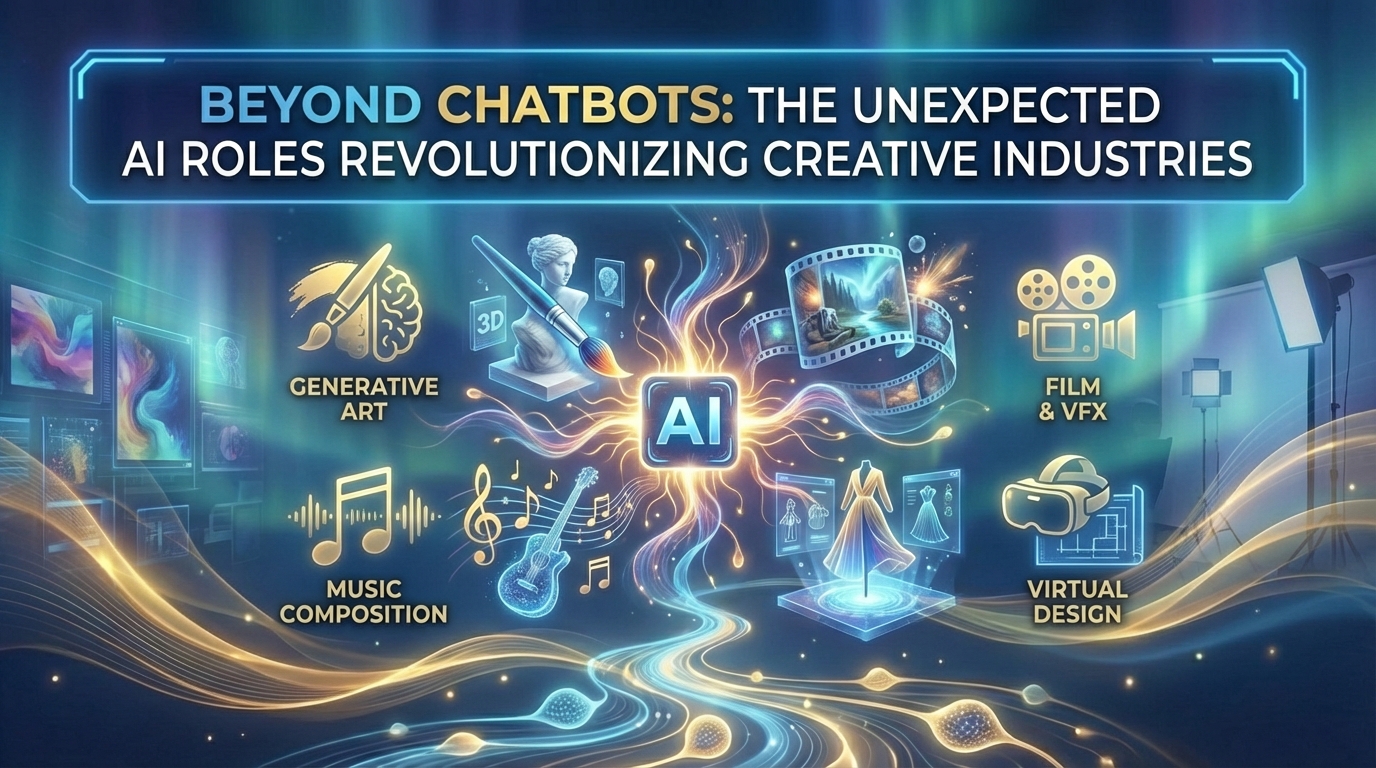
The first wave of AI creativity was mostly about one-off experiments: a surprising image here, a surreal portrait there. The current wave looks very different. Generative art has matured into a repeatable production system, and many studios now treat AI as a standard tool in their creative stack. Visuals that used to take days of reference gathering can now be prototyped in minutes. Creative directors can explore entire style families rapidly, then refine a single direction with human art direction. The new role AI plays here is creative divergence — a controlled chaos engine that expands the idea space quickly so humans can focus on curation and narrative cohesion.
Music Composition: AI as Co-Writer, Not Replacement
AI has created a new role in music: the co-composer that provides harmonic scaffolding, suggests melodic variations, and accelerates scoring workflows. Music directors can generate multiple short sketches in different emotional palettes, select a mood fast, and then refine. Content teams can produce multiple variations of a track for different regions and campaign lengths without rebuilding from scratch. The core shift is experimentation cost: instead of starting from silence, composers start from options. The human role becomes more curatorial and narrative-focused, while AI handles the initial exploration.
Film and VFX: AI as the Invisible Pipeline Multiplier
The most radical AI impact is in film and VFX, where budgets and timelines are traditionally brutal. AI is embedded across production in ways that shorten timelines, reduce costs, and open the door for smaller studios to achieve blockbuster-level output. In pre-visualization, AI generates early scene mockups, lighting studies, and shot suggestions before a camera ever rolls. In post, AI accelerates rotoscoping, masking, background cleanup, set extension, motion tracking, stabilization, and even color exploration. These tasks used to be expensive and time-consuming; now they happen faster, freeing artists to focus on the creative, high-value work. The biggest downstream effect is VFX democratization: smaller teams can execute scenes that once required massive headcount.
Virtual Design: From Product to World-Building
Virtual design is one of the most important hidden revolutions. AI moves designers from static mockups into a world where environments, products, and digital experiences can be prototyped and tested at speed. Virtual set design for creators, interactive brand environments for events, and high-fidelity product visualization all benefit from faster iterations. The feedback loop changes: instead of waiting for full renders, teams generate fast approximations that are good enough for decision-making, compressing approval cycles and reducing wasted design effort.
Creative Direction: AI as the Brief Generator
One of the most under-discussed AI roles is its impact on creative strategy. AI is increasingly used to generate briefs, concept directions, and audience-specific messaging. A strong brief is the foundation of good work. AI can synthesize market research, brand voice, campaign objectives, and audience data into a structured brief in minutes. That means faster campaign kickoffs, fewer rounds of clarification, and tighter alignment between strategy and execution.
Creative Operations: The Hidden Backbone
AI is quietly reshaping the operational side of creative businesses. Agencies, studios, and in-house teams are using AI to automate versioning, generate metadata and searchable libraries, create platform-specific exports at scale, and summarize feedback into clean revision queues. It is not glamorous, but it is transformational. The less time teams spend on creative operations, the more they can invest in actual creation.
The New Creative Stack: Hybrid by Default
The future is not AI versus human. It is hybrid by default. The best creative teams are building workflows where AI handles exploration and acceleration, humans handle narrative, taste, and final polish, and the loop between the two is fast and iterative. This hybrid model is becoming the standard across design, film, music, and visual arts.
Cultural Impact: New Formats and New Business Models
AI is not just speeding up existing workflows. It is enabling new creative formats: interactive visual narratives, personalized music and soundscapes, dynamic product designs tailored to the user, and AI-native films built by small teams. This unlocks new business models for creators who can ship more work, test more ideas, and personalize output at scale.
AI as the R&D Engine of Creativity
The most important role AI is taking on is creative R&D. Creative industries have historically lacked the bandwidth to experiment at scale. AI makes experimentation cheap and fast, which is why we are seeing a wave of creative breakthroughs. The shift is not only about power — it is about speed, breadth, and iteration.
Final Takeaway: The Role Shift Is Permanent
AI is not a temporary trend. It is a structural shift in how creative industries operate. The role of the creator is evolving from maker to director of systems. The most successful creatives in the coming years will not just master tools. They will master pipelines that expand their creative range without diluting their voice.
The teams that build these hybrid workflows first will define the creative standards of the next decade.