AI Strategy Jan 3, 2026 8 min read
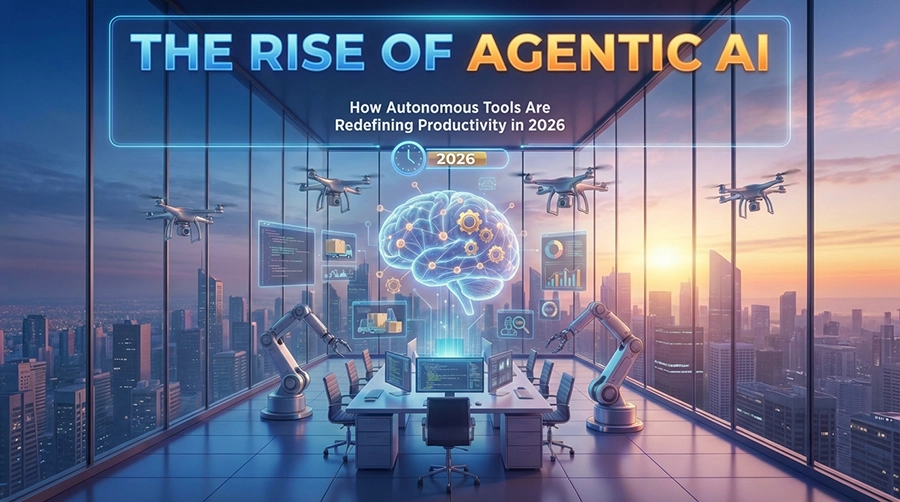
The Rise of Agentic AI: How Autonomous Tools Are Redefining Productivity in 2026
The landscape of artificial intelligence is shifting from reactive tools to proactive agents. In 2026, we are witnessing the widespread adoption of "Agentic AI"—systems that don't just answer questions but execute multi-step tasks autonomously, effectively acting as digital employees.
What is Agentic AI?
Unlike traditional AI that requires constant prompting, agentic systems have the ability to plan, use specialized tools, and self-correct. For businesses, this means moving from "AI assistance" to "AI orchestration." These agents can manage your inbox, research competitors, and update your project management boards without you ever lifting a finger.
The Power Players of 2026:
* **Lindy: Leading the charge in personal AI assistants. Lindy doesn't just draft emails; she manages your entire calendar, attends meetings on your behalf, and handles complex back-and-forth scheduling that used to take hours.
* Laxis: Revolutionizing the way we capture intelligence. Laxis is an AI meeting assistant that goes beyond simple transcription. It extracts high-level strategic insights and automatically syncs them with your CRM, ensuring your sales team never misses a beat.
* n8n: The absolute powerhouse for technical founders. n8n allows you to build sophisticated autonomous workflows. By connecting different apps through an agentic framework, you can build a self-operating business engine that runs 24/7.
Implementing Your Agentic AI Stack: A Strategic Roadmap
The transition to agentic AI isn't about replacing your entire workflow overnight—it's about strategically identifying bottlenecks and deploying autonomous solutions where they'll have the highest impact. The most successful early adopters in 2026 are following a three-phase approach: audit, deploy, and orchestrate.
Start by conducting a ruthless audit of your time. For the next week, track every task that takes more than 15 minutes and ask yourself one critical question: "Does this require my unique human judgment, or am I just acting as a coordinator?" Most founders discover that 60-70% of their day involves tasks that fall into the coordination category—scheduling, follow-ups, data entry, and information synthesis. These are your prime targets for agentic automation.
Once you've identified your bottlenecks, the deployment phase begins with your communication layer. Lindy excels here because she operates with genuine autonomy rather than simple automation. Instead of setting rigid rules like "schedule meetings on Tuesdays," you can give Lindy contextual instructions like "prioritize deep work in the mornings and keep client calls to afternoons when my energy for social interaction peaks." She learns your preferences, negotiates with other parties' scheduling systems, and handles the inevitable reschedules that would otherwise fragment your attention throughout the day. The key is to start with one high-friction area—most users begin with calendar management—and expand her responsibilities as trust builds.
For teams that live in meetings, Laxis transforms how you capture and leverage conversational intelligence. The traditional approach of assigning a note-taker or scrambling to remember action items after a call creates gaps in your institutional knowledge. Laxis attends your meetings as a silent participant, but her real power emerges in what happens afterward. She doesn't just transcribe words; she identifies commitments, extracts strategic decisions, and automatically updates your systems of record. A sales team using Laxis can walk out of a discovery call and find their CRM already updated with pain points, budget information, and next steps—all without touching a keyboard. The implementation tip here is to integrate Laxis with your existing tools from day one rather than treating it as a standalone transcription service.
The third pillar, n8n, is where the magic of true agentic orchestration happens. While Lindy and Laxis operate within their defined domains, n8n allows you to build custom agents that connect your entire business ecosystem. Think of it as the nervous system that allows different parts of your operation to communicate and act without your constant supervision. A sophisticated n8n workflow might monitor your support inbox, categorize incoming requests, route technical questions to your documentation AI, handle refund requests automatically up to a certain threshold, and only escalate genuinely complex issues to your human team. The learning curve is steeper than consumer-friendly tools, but the payoff is a business that operates with an intelligence layer running beneath every process.
The critical mindset shift that separates successful agentic adopters from those who struggle is understanding the difference between delegation and orchestration. When you delegate to a human employee, you're offloading a task but maintaining the same basic workflow. When you orchestrate with agents, you're redesigning the workflow itself. Instead of thinking "I need someone to manage my inbox," think "I need an intelligent filtering system that routes information to the right action pathway." Instead of thinking "I need someone to take meeting notes," think "I need to extract decision-relevant intelligence from conversations and inject it into downstream systems automatically."
The founders seeing the most dramatic results are those who embrace what we call "agent-first design." Before hiring a new team member or building a new process, they ask: "Could an agent handle this autonomously, with human oversight?" More often than not, the answer is yes. This doesn't mean eliminating humans from your business—it means elevating them to work that genuinely requires human creativity, relationship-building, and strategic judgment while agents handle the connective tissue that holds operations together.
Why Your Business Needs an Agentic Strategy
In the hyper-competitive market of 2026, efficiency is the only moat. By deploying agents from the Skowers Directory, founders are scaling operations to seven figures with zero headcount growth. The barrier to entry has never been lower, especially with tools offering Free Trials to get you started.
The role of the modern entrepreneur has officially shifted: you are no longer the operator; you are the Chief AI Architect**.