
Tutorial Dec 20, 2025 15 min read
Building a $10k/mo Micro-SaaS using n8n and Gamma in 24 Hours
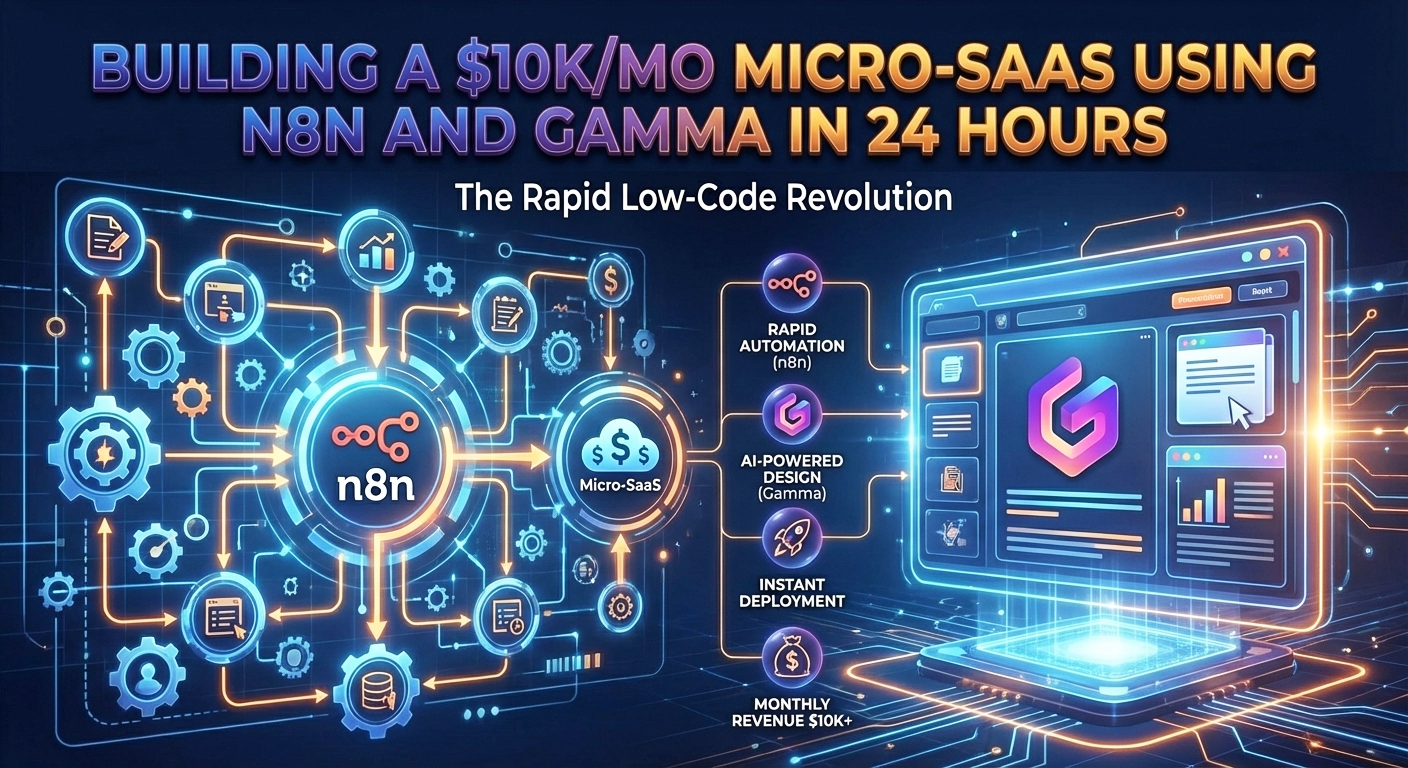
In this exclusive technical breakdown, we show you how to build a fully functional micro-SaaS business using the power of automation and generative design. We utilize **n8n for the backend logic and Gamma for creating instant, high-converting landing pages and sales decks.
The 24-Hour Micro-SaaS Blueprint: From Concept to Revenue
The promise of building a $10k/mo business in 24 hours sounds like entrepreneurial fantasy, but in 2026, the combination of no-code automation and AI-powered design has made this timeframe genuinely achievable. The key is understanding that you're not building software from scratch—you're orchestrating existing tools into a valuable service that solves a specific problem better, faster, or cheaper than current solutions.
Hour 0-3: Identifying Your High-Value Problem Space
The difference between a micro-SaaS that reaches $10k/mo and one that stalls at $500 is problem selection. You need a problem that meets four criteria: it's painful enough that people will pay for a solution, it's repetitive enough to automate, it's currently solved manually or with expensive enterprise tools, and it's narrow enough that you can dominate a niche.
The goldmine opportunities in 2026 exist at the intersection of two established tools or workflows. For this guide, we'll build a concrete example: an automated LinkedIn content analyzer for B2B sales teams. The problem is real—sales teams spend hours manually reviewing LinkedIn activity of prospects to find conversation starters, but this research is tedious, inconsistent, and often skipped. Our micro-SaaS will automatically monitor target prospects, analyze their LinkedIn activity, and deliver personalized talking points to sales reps each morning.
Before writing a single line of code or building any workflow, validate demand with what we call "concierge validation." Offer to manually deliver this service to 5 potential customers for free in exchange for feedback. If you can't find 5 people willing to use it for free, you don't have a viable business. In our LinkedIn analyzer example, you'd manually check LinkedIn daily for your test users and send them a simple email with insights. If they actively use this information and report value, you've validated the problem.
Hour 3-8: Building Your Core Automation in n8n
This is where n8n becomes your unfair advantage. While competitors are hiring developers and spending months building infrastructure, you're connecting APIs and building sophisticated workflows in hours. n8n's visual interface makes it accessible to non-developers, but its power lies in its ability to handle complex logic, error handling, and integrations that would typically require custom code.
Starting with n8n's workflow canvas, you'll build what we call the "core value loop"—the automated process that delivers your service's primary benefit. For our LinkedIn analyzer, the workflow looks like this:
Step 1: Data Collection Trigger
Set up a Schedule Trigger node that runs every morning at 6 AM. This will initiate your daily analysis cycle. In n8n, this is literally drag-and-drop—add the Schedule Trigger** node, set it to CRON expression 0 6 * * *, and you're done. This single node replaces what would traditionally require a server, cron job management, and monitoring infrastructure.
Step 2: Customer Database Query
Add a database node (**n8n supports Postgres, MySQL, MongoDB, or even Airtable) that pulls the list of active customers and their prospect lists. The SQL query is simple: SELECT customer_email, prospect_linkedin_urls FROM customers WHERE status = 'active'. Each customer record should include the LinkedIn profiles they want monitored. For early validation, Airtable works perfectly as your database—it's visual, easy to update, and n8n has native integration.
Step 3: LinkedIn Data Extraction
Here's where it gets interesting. LinkedIn doesn't offer a generous public API, but there are several approaches. The most reliable in 2026 is using a service like Phantombuster or Apify (both integrate directly with n8n) to scrape public LinkedIn activity. Add an HTTP Request node that calls Phantombuster's API for each prospect, extracting their recent posts, comments, and profile updates from the past week. The key configuration: set the node to run in batches to avoid rate limiting, typically 5 profiles at a time with a 2-second delay between batches.
Step 4: AI Analysis and Insight Generation
This is your secret sauce. Add an OpenAI node (n8n has native ChatGPT integration) that sends the LinkedIn activity data with a carefully crafted prompt: "You are analyzing LinkedIn activity to help a sales professional find conversation starters. Given this person's recent posts and comments: [data], provide 3 specific talking points the sales rep could use. Each talking point should reference something specific they posted or commented on and suggest how to naturally bring it up in conversation. Be concise and actionable."
The prompt engineering here is critical. Generic summaries don't create value; specific, actionable talking points do. Spend time refining this prompt until the output would genuinely help you if you were the sales rep. This might take a few iterations, but it's the core of your product differentiation.
Step 5: Formatting and Personalization
Add a Function node (n8n lets you write custom JavaScript) that takes the AI-generated insights and formats them into a clean, scannable email template. Your code might look like:
`javascript
const insights = $input.all();
let emailBody = \`Good morning! Here are today's conversation starters for your prospects:\\n\\n\`;
for (let insight of insights) {
emailBody += \`📊 \${insight.prospect_name}\\n\`;
emailBody += \` • \${insight.talking_points.join('\\n • ')}\\n\\n\`;
}
return { emailBody };
`
This transforms raw AI output into a professional-looking briefing that sales reps will actually read and use.
Step 6: Delivery
Add a Gmail or SendGrid node to deliver the daily briefing to each customer. Configure the subject line to be personalized: "Your Daily Sales Intelligence - [Date]" and set the email body to the formatted insights from the previous step. Pro tip: Also log successful deliveries to your database so you can track engagement metrics later.
Step 7: Error Handling and Monitoring
This separates amateur automation from production-ready services. Add Error Trigger nodes that catch failures at critical points—if the LinkedIn scraper fails, if the AI API is down, if email delivery bounces. Route these errors to a Slack notification (another simple n8n node) so you're immediately aware of issues. In the early days, you'll manually fix problems. As you scale, you'll add retry logic and fallback mechanisms.
The entire n8n workflow should have 15-20 nodes total and, once configured, runs completely autonomously. Test it thoroughly with your own LinkedIn profile and email address before connecting real customers. The testing phase is critical—run it daily for a week, refining the prompts and error handling until the output is consistently valuable.
Hour 8-12: Creating High-Converting Marketing Assets with Gamma
While your automation is running test cycles, shift focus to creating the marketing materials that will drive customer acquisition. This is where Gamma becomes transformational. Traditional landing page builders require design skills, coding knowledge, or expensive templates. Gamma's AI design engine lets you go from concept to professional-grade marketing site in under an hour.
Building Your Landing Page
Open Gamma and start with a prompt that describes your entire value proposition: "Create a landing page for a B2B sales tool that automatically analyzes LinkedIn activity of prospects and delivers personalized conversation starters to sales reps every morning. Target audience is sales directors at 50-500 person companies. Key benefits: save 5+ hours per week on research, never miss important prospect updates, increase connection rates by having relevant conversation starters. Include sections for: hero with value prop, how it works (3 steps), pricing (single tier at $99/mo), testimonials placeholder, and CTA to start free trial."
Gamma's AI will generate a complete, visually cohesive landing page in 30-60 seconds. But here's the pro move: don't just accept the first version. Iterate on specific sections. If the hero section isn't punchy enough, highlight that section and prompt: "Make this more compelling by leading with the pain point—sales reps wasting hours on LinkedIn research." If the "how it works" section is too vague, refine it: "Make this more specific with actual screenshots and concrete details about the daily email briefing."
The advantage of Gamma over traditional page builders is that you're collaborating with AI on the design itself. Instead of dragging boxes around or picking from templates, you're describing what you want and iterating on the output. The result is a custom design that actually reflects your product's unique value proposition rather than looking like every other landing page template.
Creating Your Sales Deck
Once your landing page is solid, use Gamma to create a sales deck that you'll use for outbound outreach and demo calls. Prompt: "Create a 10-slide sales presentation for [your product]. Include: problem statement with statistics, current solutions and their limitations, our approach, live demo walkthrough, ROI calculation, case study, pricing, implementation timeline, FAQ, and next steps."
The resulting deck will have professional layouts, but here's where you add your secret weapon: actual screenshots and data from your working automation. Replace Gamma's placeholder images with screenshots of the daily email your prospects will receive, the n8n workflow running successfully, and if you have them, early testimonials from your validation customers.
Designing Your Lead Magnet
The best micro-SaaS businesses don't rely solely on their product landing page for acquisition. Create a valuable lead magnet that attracts your target audience. For our LinkedIn analyzer example, you might create a guide: "The Complete Framework: How Top Performing Sales Teams Use LinkedIn Intelligence to 3x Their Connection Rates."
Prompt Gamma: "Create a 5-page downloadable guide about using LinkedIn for B2B sales outreach. Include: introduction to social selling, common mistakes sales teams make, framework for identifying high-value prospects, templates for conversation starters, and actionable steps. Use professional but approachable tone. Include data visualization and visual examples."
This lead magnet serves two purposes: it attracts potential customers through content marketing, and it positions your automated tool as the logical next step for people who want these insights without manual work. Host the PDF on your landing page behind an email signup form (we'll automate the delivery in n8n).
Hour 12-16: Integration, Testing, and Refinement
Now you connect your automation backend to your marketing frontend. This is where many founders stumble—they build pieces in isolation without thinking through the complete customer journey.
Setting Up Customer Onboarding Automation
Create a second n8n workflow triggered when someone signs up for your service. The workflow should:
1. Webhook Trigger: Set up a webhook URL that your landing page's signup form posts to. Most form tools (Typeform, Tally, even Google Forms via Zapier bridge) can send data to a webhook. Configure the webhook in n8n to receive customer email, company name, and the LinkedIn URLs they want monitored.
2. Database Entry: Add a node that inserts this new customer into your Airtable or database with status "trial", trial_end_date set to 14 days from now, and created_at timestamp.
3. Welcome Email Sequence: Trigger an automated welcome email that sets expectations: "Welcome! Your first LinkedIn intelligence briefing will arrive tomorrow morning at 6 AM. In the meantime, here's what to expect and how to get the most value..."
4. Slack Notification: Send yourself a notification that you have a new trial user. In the early days, you'll want to personally reach out to ensure they're getting value.
5. Add to Daily Analysis: Ensure their prospects are immediately added to tomorrow's analysis run. Nothing kills conversion faster than signing up and then waiting days to see value.
Implementing Payment Processing
For a micro-SaaS, Stripe is the standard. The cleanest implementation is using Stripe Checkout—it handles the entire payment page, security, and compliance for you. Create a product in Stripe for your $99/mo subscription, then add a "Subscribe" button to your Gamma landing page that links to the Stripe Checkout URL.
The critical n8n workflow here handles post-payment actions:
1. Stripe Webhook: When someone completes payment, Stripe sends a webhook. Set up an n8n webhook to receive checkout.session.completed events.
2. Upgrade Status: Update the customer's database record from "trial" to "paid" and set billing_period_end to 30 days from now.
3. Confirmation Email: Send a payment confirmation and set expectations about their subscription.
4. Analytics Tracking: Log this conversion in your analytics (even if it's just a Google Sheet for now) so you can calculate customer acquisition costs and conversion rates.
Building Cancellation and Support Workflows
The reality of SaaS is that people will cancel, have questions, and encounter issues. Anticipate this:
Create a simple cancellation form on your site (can be a Google Form) that feeds into n8n. When someone cancels, the workflow should: update their database status to "cancelled", schedule their service to stop at period end (honor their paid time), send a cancellation confirmation, and critically—trigger a brief survey asking why they're cancelling. This feedback is gold for improving your product.
For support requests, set up a simple email address (support@yourdomain.com) that triggers an n8n workflow to create a ticket in Airtable and notify you in Slack. In the early days, you'll handle support manually, but you're building the infrastructure to automate or delegate this later.
Hour 16-20: Launch Strategy and Initial Traction
Your product is built and tested. Now it's time to get your first paying customers. The micro-SaaS model allows for scrappy, high-leverage launch tactics that would never work for traditional software companies.
Direct Outreach to Validated Prospects
Remember those 5 people you manually delivered the service to during validation? They're your first conversion targets. Reach out personally: "I've now automated the LinkedIn intelligence briefing I was manually sending you. Would you like to continue receiving it? The service is $99/mo, but I'd love to offer you a founding member rate of $49/mo for life since you helped validate this."
Your conversion rate here should be 60%+ if the service genuinely helped them. These first 2-3 customers give you testimonials, feedback, and most importantly—revenue that proves the model works.
Strategic Community Engagement
Identify where your target customers congregate online. For B2B sales tools, that's LinkedIn (obviously), sales-focused Slack communities, Reddit communities like r/sales, and niche forums. Don't spam your product—instead, contribute genuinely valuable insights about LinkedIn-based prospecting and let your expertise create curiosity.
A winning LinkedIn post might be: "After analyzing 1,000+ LinkedIn profiles for sales research, here's the #1 mistake I see sales reps make..." and share a genuine insight from your analysis work. End with: "If you want these insights delivered automatically each morning, I built a tool for that—DM me for details." This positions you as an expert while creating a natural pathway to your product.
Content-Driven SEO Play
Use your Gamma-created lead magnet to start building organic traffic. Publish it on your site, then write supporting blog posts that rank for long-tail keywords: "how to use LinkedIn for B2B sales prospecting", "LinkedIn research for sales teams", "automating LinkedIn lead research". These posts should link to your lead magnet, which links to your product.
The SEO timeline is longer (3-6 months to see meaningful traffic), but you're building a compounding asset. Write one high-quality article per week, and within a quarter, you'll have organic leads coming in.
Paid Acquisition Testing
With a $99/mo product, you can afford up to ~$200 customer acquisition cost and still build a healthy business. Test small budgets on LinkedIn Ads (since that's where your audience is) with a simple offer: "Sales reps are saving 5+ hours per week with automated LinkedIn intelligence. Try free for 14 days."
Start with $20/day budget, target sales managers and directors at companies with 50-500 employees, and drive them to your Gamma landing page. Track everything obsessively—which ad copy performs, what conversion rate you're seeing, how long trial users take to convert to paid. After spending $500-1000, you'll know if paid acquisition is viable for your business.
Partnership and Affiliate Strategy
Identify complementary tools and services. For a LinkedIn analyzer, that might be CRM companies, sales training consultants, or LinkedIn automation tools. Reach out with a partnership proposal: "I've built a LinkedIn intelligence tool that would be valuable for your customers. Would you be open to an affiliate arrangement where you earn 20% recurring commission for referred customers?"
Many SaaS businesses reach $10k/mo primarily through 2-3 strategic partnerships rather than through their own marketing efforts.
Hour 20-24: Optimization and Scaling to $10k/mo
The path to $10k/mo is simple math: 100 customers at $99/mo, or 50 customers at $199/mo. Your final hours should focus on removing friction from the conversion path and building systems for sustainable growth.
Conversion Rate Optimization
Your biggest leverage point is conversion rate. If you're driving 100 trial signups per month but only converting 10% to paid, that's 10 customers and ~$1,000 MRR. Improving that to 20% conversion doubles your revenue with the same traffic.
The highest-impact conversion improvements:
1. Onboarding Email Sequence: Most SaaS businesses lose trials due to lack of engagement, not lack of value. Build an n8n workflow that sends strategic emails during the trial: Day 1 - Welcome and expectation setting, Day 3 - "Here's how [customer name from testimonial] uses daily briefings to improve their outreach", Day 7 - "You're halfway through your trial—have questions?", Day 12 - "Your trial ends in 2 days—subscribe now to keep your briefings coming".
2. Usage-Based Triggers: Set up n8n to monitor engagement. If someone hasn't opened their briefing emails in 3 days, trigger an intervention: "We noticed you haven't been opening your briefings—is the timing wrong? Would you prefer them at a different hour? Or is something else not working?" This shows you care and often saves trials that would otherwise lapse.
3. Social Proof: Add every legitimate testimonial to your Gamma landing page. Even better, create short video testimonials (you can do this over Zoom calls with happy customers) and embed them on your site. Social proof is the #1 converter for B2B SaaS.
Calculating and Optimizing Unit Economics
This is where founders often get delusional about their business viability. Calculate your true unit economics:
- Customer Acquisition Cost (CAC): Total marketing and sales spend divided by number of new customers acquired. If you spent $500 on ads and got 5 customers, your CAC is $100.
- Lifetime Value (LTV): Average customer monthly payment × average months they stay subscribed. If customers pay $99/mo and stay for 8 months on average, LTV is $792.
- LTV:CAC Ratio: You want this above 3:1 for a healthy business. In our example, $792 LTV / $100 CAC = 7.9:1, which is excellent.
Track these metrics in a simple spreadsheet. When your LTV:CAC ratio is strong, you can confidently invest more in acquisition knowing you'll recoup it.
Retention and Expansion Revenue
Reaching $10k/mo is one milestone; staying there requires retention. The average micro-SaaS sees 5-8% monthly churn (meaning 5-8% of customers cancel each month). That means if you're not acquiring new customers, your MRR will decay by half every year.
Combat churn with:
- Continuous Value Delivery: Your daily briefings must remain consistently valuable. Monitor the AI output quality weekly and refine prompts as needed. If LinkedIn changes something or your data quality degrades, customers will notice and cancel.
- Proactive Check-ins: Set up n8n to flag customers who have been with you for 3, 6, and 12 months. Send them personal emails asking for feedback and offering to customize their experience. This human touch dramatically reduces churn.
- Upsell Opportunities: Once someone is getting value at $99/mo for 25 prospects, offer them a $199/mo tier for 100 prospects. Or add features like integration with their CRM so talking points automatically appear when they look at a prospect record. Expansion revenue is easier than new customer acquisition.
Building for $10k/mo and Beyond
Here's the math to $10k/mo with our example pricing:
- Month 1: 10 customers = $990 MRR (from your validation group, direct outreach, early community engagement)
- Month 2: +15 customers = $2,475 MRR (continuing outreach, first SEO traction, partnership conversations started)
- Month 3: +20 customers = $4,455 MRR (first paid ads working, partnership sending referrals, word of mouth beginning)
- Month 4: +25 customers, -3 churned = $6,633 MRR (paid acquisition scaling, organic traffic building)
- Month 5: +30 customers, -4 churned = $9,261 MRR (multiple channels working, compounding effects)
- Month 6: +15 customers, -5 churned = $10,746 MRR (sustainable growth, retention focus)
This timeline is achievable because you're not building a complex product—you're delivering a focused solution to a specific problem using orchestrated automation. Your competitive advantage is speed to market and focused value delivery, not technical sophistication.
The Post-Launch Reality Check
The 24-hour build is real, but reaching $10k/mo typically takes 4-6 months of consistent execution. The n8n workflows and Gamma marketing assets give you the foundation to move fast, but sustainable growth requires:
- Relentless Focus on Customer Success: Every churned customer sets you back. Obsess over making sure customers get value.
- Systematic Experimentation: Test new acquisition channels, messaging, pricing, and features constantly. Track what works and double down.
- Build in Public**: Share your journey, your metrics, and your learnings. The transparency builds an audience that becomes a customer base.
The real power of this approach isn't just that you can build quickly—it's that you can learn quickly. If your first idea doesn't work, you've only invested 24 hours and minimal capital. Pivot to a new problem space and rebuild in another 24 hours. The low cost of experimentation is your unfair advantage.
---
*Disclaimer: Building a Micro-SaaS requires consistent effort and strategic execution. Revenue figures are examples of what is possible with a validated product and successful marketing. Always ensure compliance with third-party terms of service when automating data extraction.*