
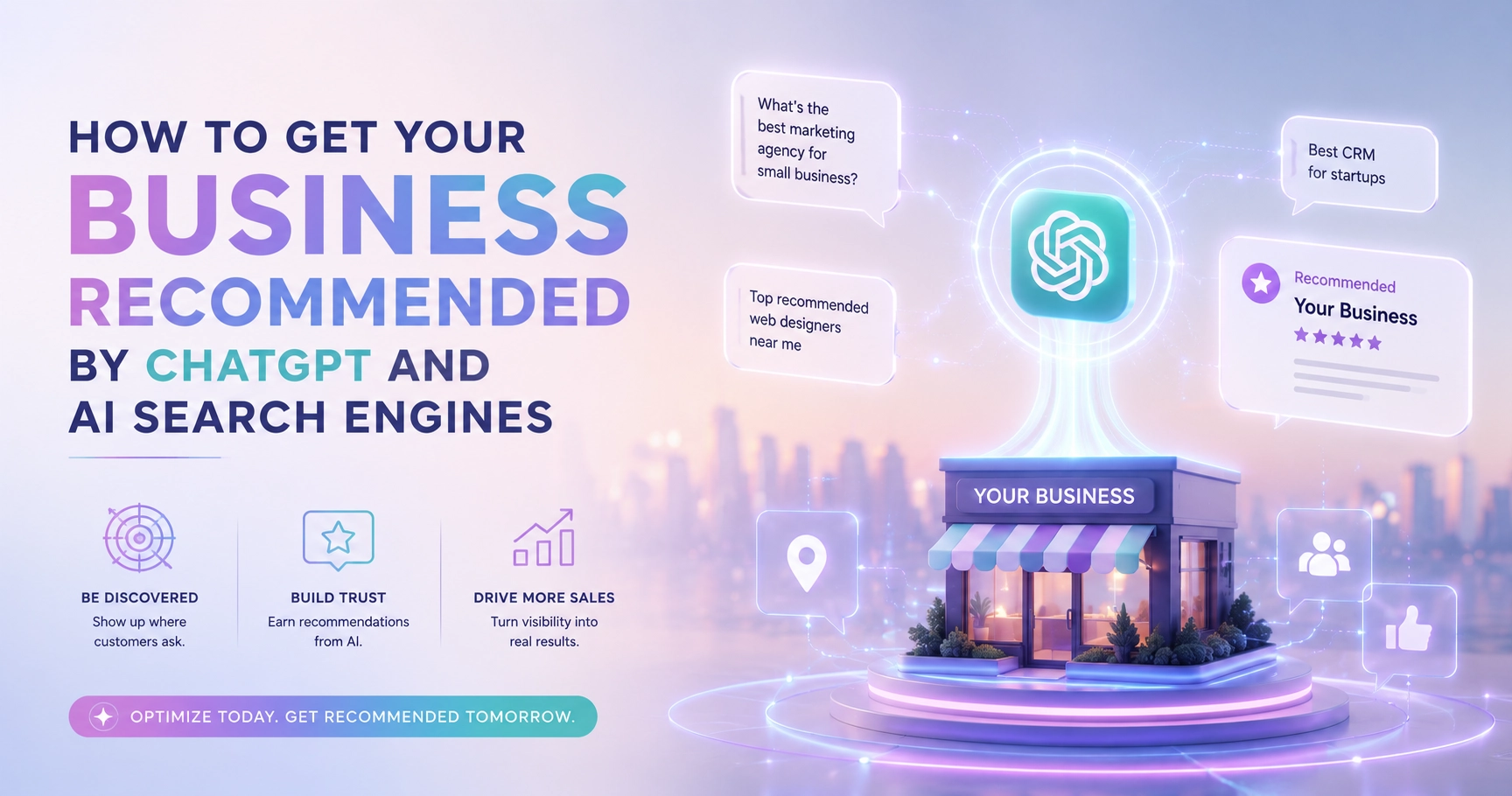
How to Get Your Business Recommended by ChatGPT and AI Search Engines

More buyers are asking AI tools for recommendations before they ever visit a traditional search results page. They ask questions like "what is the best CRM for a small agency," "which AI tool should I use for customer support," or "what software helps local businesses automate follow-up?"
That changes the marketing game. Ranking on Google still matters, but businesses also need to become easy for AI systems to understand, trust, compare, and cite.
This is often called AI search optimization, answer-engine optimization, or generative engine optimization. The name matters less than the goal: make your business clear, credible, and useful enough to be included when AI tools summarize options.
What AI Search Engines Need Before They Recommend You
AI systems tend to favor information that is clear, consistent, specific, and supported by external signals. If your site is vague, thin, outdated, or hard to parse, you make the recommendation harder.
Strong AI visibility starts with five basics:
- A clear description of who the product or business is for.
- Dedicated pages for important use cases and categories.
- Comparison content that explains alternatives honestly.
- Fresh articles that answer buyer questions in plain language.
- Mentions, citations, reviews, directories, and trusted third-party references.
If you want to show up in AI answers, your content needs to sound less like a slogan and more like a useful buyer brief.
Step 1: Build Pages Around Buyer Questions
Generic pages are weak. Buyer-intent pages are stronger because they match how people ask AI tools for help.
Instead of only writing "AI marketing software," create pages and articles around searches like:
- best AI tools for customer support
- best AI sales tools for B2B outreach
- AI agents for small business
- AI tools for local business marketing
- ChatGPT alternatives for research
- AI automation tools for ecommerce
Each page should explain who the tool is for, when it is a bad fit, what it costs to test, what alternatives to compare, and what first workflow a buyer should try.
Step 2: Track AI Visibility
You cannot improve what you never check.
RankPrompt is built for the new AI visibility problem: understanding how brands and sites appear inside AI-generated answers. If your business depends on being discovered in AI search, this is one of the first tools to compare.
Use RankPrompt to watch how prompts, categories, competitors, and recommendation patterns change. The goal is not just ranking for a keyword. The goal is knowing whether AI answers understand your brand correctly.
Step 3: Improve Technical and Content Quality
AI search still depends on crawlable, structured, high-quality web content. If your site has weak titles, thin pages, missing internal links, or outdated articles, fix those before chasing advanced tactics.
OmniSEO and SEOSparkPlug are useful for improving search visibility fundamentals. They can help teams review content structure, optimization gaps, technical SEO issues, and pages that need better relevance.
For a directory, agency, SaaS company, or local business, this matters because AI engines need clean context. A page that clearly explains "best for," "features," "pricing model," "alternatives," and "use cases" is easier to understand than a short promotional page.
Step 4: Create Useful Comparison Content
AI recommendation queries are often comparison queries. People want to know what to choose, not just what exists.
High-converting comparison content should include:
- Best overall option.
- Best low-cost option.
- Best for small teams.
- Best for sales, marketing, support, or operations.
- Best first workflow to test.
- Common mistakes before buying.
This type of content converts because it helps the visitor make a decision. It also gives AI systems clearer material to summarize.
Step 5: Watch Competitors and Public Mentions
AI visibility is not only about your own website. Mentions across the web can shape whether your brand looks trustworthy and relevant.
Browse AI can help monitor public pages, competitor lists, review pages, directories, and market changes. Use it to watch where competitors are being mentioned and where your own site may need better coverage.
Pair that with Databox if you want a dashboard for content performance, traffic, conversions, and lead quality.
30-Day AI Search Visibility Plan
Week 1: Pick five buyer questions your target customer is already asking. Create or update one dedicated page for each.
Week 2: Add comparison sections, FAQs, pricing notes, use cases, and internal links to relevant tools or guides.
Week 3: Use RankPrompt to test how AI answers describe your brand and competitors.
Week 4: Improve weak pages with OmniSEO or SEOSparkPlug, then monitor public mentions and competitor pages with Browse AI.
Best First Move
Start by writing one page that answers a real buying question better than anyone else in your niche. Do not hide the answer behind fluff. Say who the product is for, who should skip it, what to compare, and what first step to take.
Then track whether AI systems understand the page. If they do not, improve clarity, add supporting content, strengthen internal links, and build more credible mentions.
For most businesses, the fastest stack to test is RankPrompt for AI visibility, OmniSEO or SEOSparkPlug for page quality, and Browse AI for monitoring the market.

Related Articles
Continue Your Research