
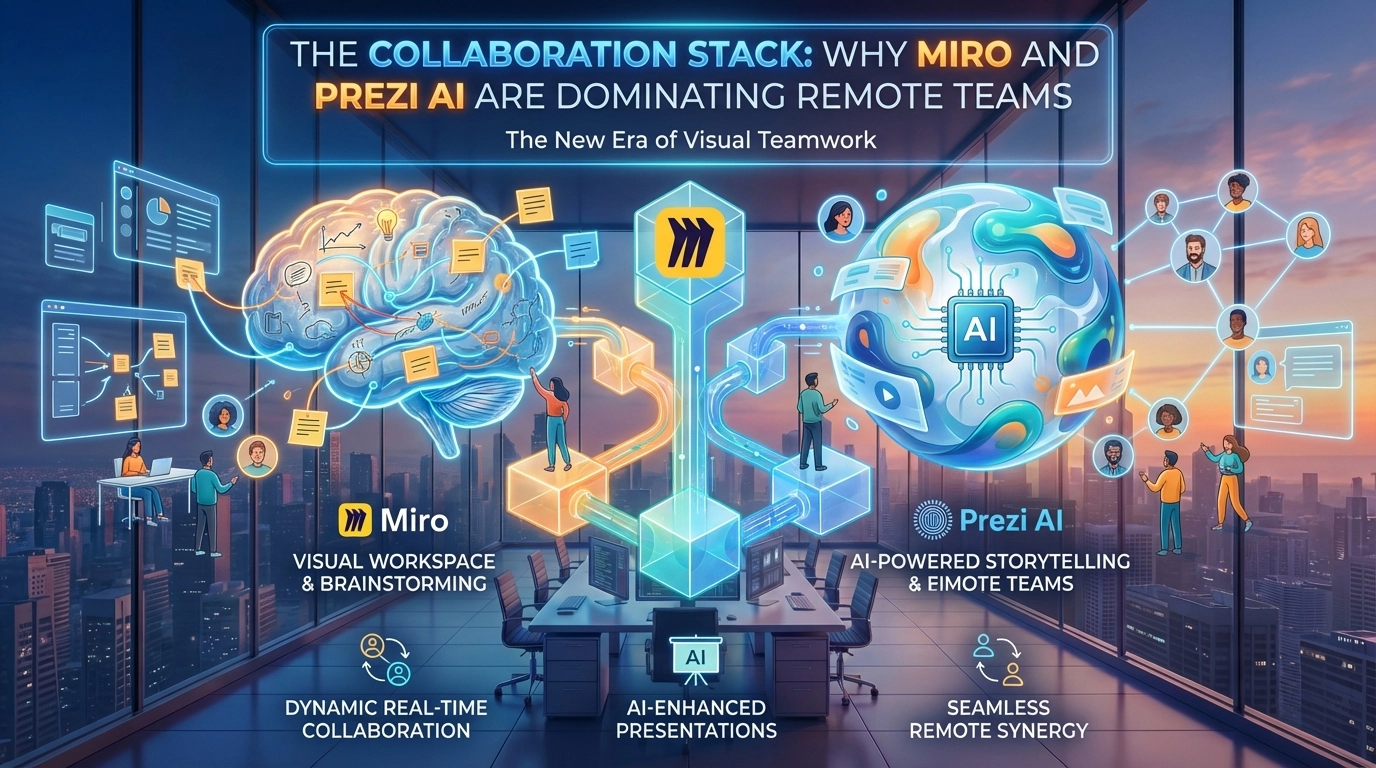
The Collaboration Stack: Why Miro and Prezi AI are Dominating Remote Teams
Remote work stopped being a Zoom calendar. Winning teams now keep a persistent visual workspace where ideas live between calls—and a storytelling layer that turns messy collaboration into stakeholder-ready narrative.
That is why searches for Miro AI, Prezi AI, remote collaboration tools, and visual whiteboard software keep rising. Documents still matter for linear specs. The costly work—brainstorming, strategy, process mapping, alignment—happens in the messy middle. Miro owns that canvas. Prezi owns the spatial pitch. Together they form the collaboration stack remote teams actually feel.
This guide shows when to use each tool, how to connect them into a workflow, how to adopt them without culture revolt, and which complementary Skowers tools fill the gaps. Track trials in the Dashboard so collaboration software does not quietly stack forever.
Why Visual Collaboration Won Remote Work
Text docs excel at policies and decisions already made. Remote teams struggle more with:
- Divergent thinking across time zones
- Cross-functional mapping (journey, process, org, roadmap)
- Turning chaos into a story executives will fund
- Meeting fatigue from "alignment" calls that could have been a board
Miro gives everyone a shared infinite canvas with templates, real-time and async contribution, and AI assist that clusters sticky chaos into frameworks. Prezi turns outlines into zoomable visual narratives that match how people remember big-picture → detail → punchline—better than another flat slide dump for high-stakes pitches.
Use documents for final policy. Use the collaboration stack for thinking and selling the thinking.
Miro: Persistent Strategy, Not Another File
Treat Miro as a living workspace, not a screenshot dump after a workshop.
Best jobs for Miro
- Async strategy and brainstorm boards
- Product discovery and journey maps
- Workshop facilitation with structured frames
- Retro and prioritization canvases
- Cross-timezone feedback without forcing a meeting
Working pattern: diverge → AI converge
- Open a board with clear lanes/prompts so people know where sticky notes go.
- Let the team add ideas asynchronously for 2–5 days.
- Use Miro Assist to cluster themes, summarize threads, and draft frameworks.
- Human owner locks priorities and next steps.
- Link agreed items into your PM system (Jira/Asana/etc.).
Example week: Mon–Wed contributors add feature ideas, customer quotes, and tech constraints. Thursday a PM asks Miro Assist to cluster and surface a prioritization skeleton. Friday the team confirms owners—often a 30-minute call instead of three hours of facilitated synthesis.
Prezi AI: From Outline to Spatial Narrative
Prezi is not "slides but funnier." It is narrative design for investor pitches, client proposals, training, and any talk where you need to move between overview and detail without losing the room.
Best jobs for Prezi
- Concept-to-canvas pitch generation from bullets
- Client storytelling and proposal walkthroughs
- Keynotes and webinars that must feel crafted
- Teaching frameworks where zoom hierarchy matters
Working pattern: think → narrate → present
- Capture raw strategy on a Miro board.
- Export/summarize the decisions into a tight outline.
- Prompt Prezi AI to build a spatial presentation from that outline.
- Replace placeholders with proof—screenshots from the board, metrics, customer quotes.
- Present from the same canvas you refined—no last-minute PowerPoint rebuild.
Consulting and agency teams win here: the engagement framework lives in Prezi early, so the delivery artifact is also the thinking artifact.
When to Prefer Gamma or Beautiful AI
The collaboration stack is Miro + Prezi first. Complementary options:
- Gamma — fastest "outline to polished docs/decks/pages" for internal updates and web-like leave-behinds.
- Beautiful AI — recurring pitch systems that need strict slide consistency every month.
Rule of thumb: messy co-creation → Miro. Zoom storytelling → Prezi. Quick stakeholder leave-behind → Gamma or Beautiful AI.
The Connected Visual Workflow
A modern remote loop looks like this:
- Ideate and align on Miro.
- Capture decisions from calls with Laxis so action items do not vanish when someone leaves the Zoom.
- Protect deep work for deck polish and board synthesis with Reclaim (and admin help from Lindy if scheduling is the silent killer).
- Convert the narrative for stakeholders in Prezi (or Gamma for simpler docs).
- Push owned tasks into your PM/CRM tools so the board is not a black hole.
That stack cuts the context-switching tax of bouncing endlessly across Slack, email, Docs, and orphaned slide folders.
Adoption Without the Culture Fight
The blocker is rarely software. It is "we already have Google Docs."
Launch on high-pain rituals first:
- Roadmap planning that always goes long
- Quarterly strategy reviews
- Cross-functional kickoffs
- Client pitches that burn designers for days
Facilitator tips:
- Pre-structure the first Miro boards; do not start with a blank void.
- Assign a board owner and a "definition of done."
- Show skeptics Miro Assist turning sticky chaos into a framework.
- Show the same for Prezi AI turning a rough outline into a pitch.
Metric that matters: synchronous meeting hours removed or shortened—not number of boards created. Many teams see meaningful meeting-time reductions in the first quarter when persistent boards replace status theater.
Three Ready Collaboration Stacks
Product / remote startup stack
- Miro for discovery and roadmaps
- Laxis for meeting memory
- Prezi or Gamma for leadership updates
- Reclaim for focus blocks
Agency / consulting stack
- Miro workshops with clients
- Prezi for proposal storytelling
- Beautiful AI for repeatable monthly decks
- Lindy for scheduling client reviews
Exec / ops alignment stack
- Persistent strategy board in Miro
- Decision capture via Laxis
- Quarterly narrative in Prezi
- Dashboard to track collaboration tool seats and renewals
30-Day Rollout Plan
Week 1 Pick one painful meeting type. Build a templated Miro board. Run one cycle async + short sync.
Week 2 Turn board outcomes into a Prezi or Gamma stakeholder narrative. Measure prep time saved vs. last quarter's deck scramble.
Week 3 Add Laxis to the recurring ritual. Enforce owned next steps leaving every call.
Week 4 Expand to a second ritual only if meeting hours and clarity metrics moved. Kill duplicate tools via Dashboard review.
Common Mistakes
- Creating 40 boards with no owners or deadlines.
- Using Miro as a screenshot archive instead of a living system.
- Building Prezi decks with no real proof from the working board.
- Forcing every document into a canvas (policies still belong in docs).
- Skipping facilitation structure, then blaming the tool for chaos.
- Buying AI collaboration seats without measuring meeting hours or cycle time.
How to Know the Stack Is Working
Track for one quarter:
- Hours in status/alignment meetings
- Time from workshop to stakeholder-ready narrative
- Number of decisions with clear owners after sessions
- Tool cost vs. designer/PM hours returned
If boards proliferate but meetings do not shrink, you bought software theater—not a collaboration stack.
Next Step
If thinking is scattered across docs and chats, start with Miro. If pitches and client stories are the bottleneck, start with Prezi. If you need fast leave-behinds, add Gamma or Beautiful AI. If meetings lose decisions, add Laxis.
Browse more collaboration tools on Skowers, trial against one painful ritual, and keep only the canvas stack that makes remote teams faster—not busier.
Related Articles
Continue Your Research