
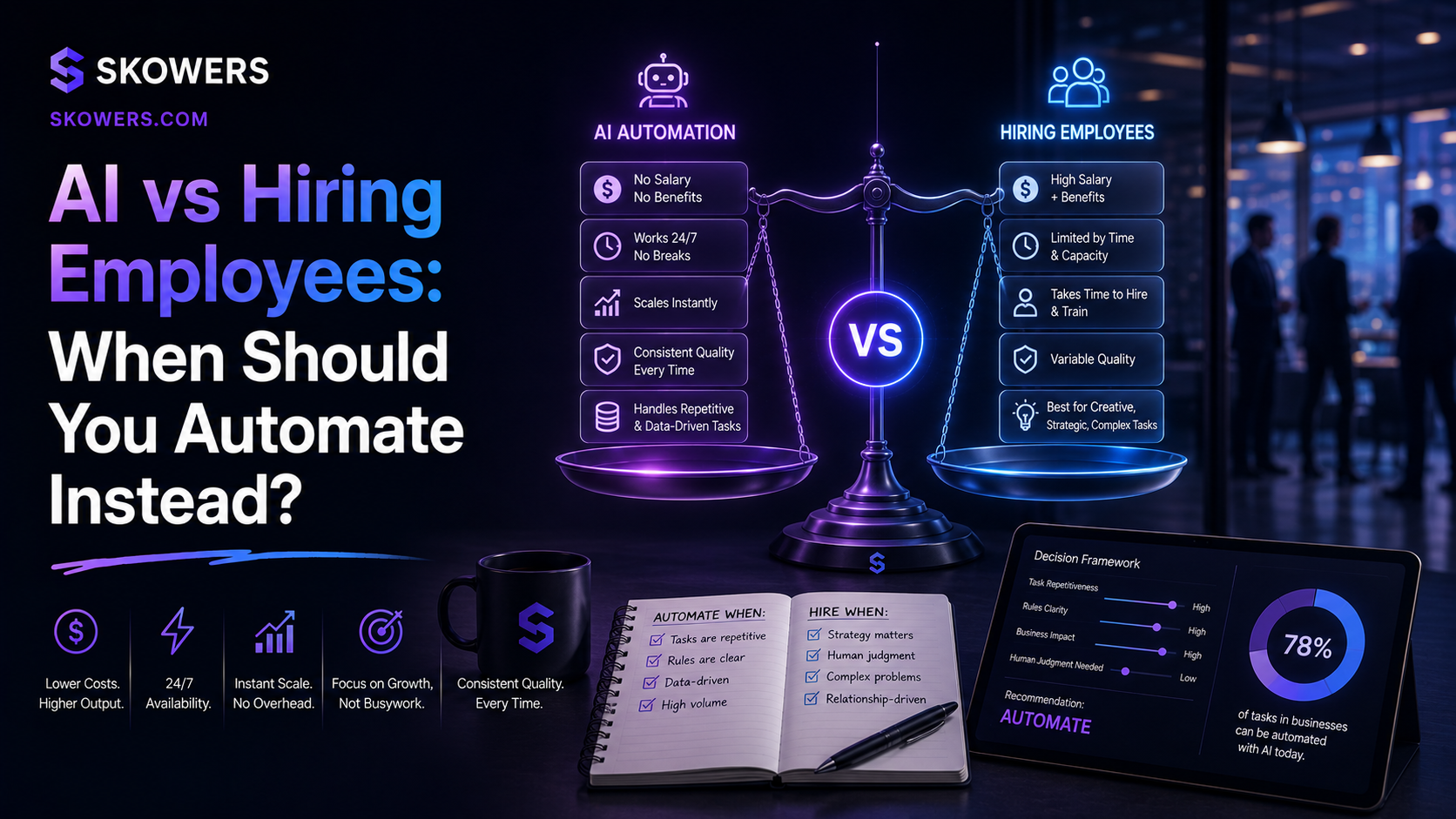
AI vs Hiring Employees: When Should You Automate Instead?
Listen: AI vs Hiring Employees: When Should You Automate Instead?

The most expensive question in a growing business is not “Which AI tool should we buy?”
It is “Do we need another employee, or do we need a better system?”
Companies often hire because work is piling up. The inbox is full, leads are waiting, reports are late, customers keep asking the same questions, and the founder is becoming the routing layer for the entire company. A new employee feels like the obvious answer.
Sometimes it is. But if the underlying work is repetitive, rules-based, measurable, and spread across disconnected software, hiring a person may add capacity without fixing the operating problem. The company pays salary, payroll costs, benefits, recruiting fees, management time, and software costs—then asks the new employee to move information between systems all day.
The opposite mistake is just as costly. Automating work that depends on trust, judgment, negotiation, creativity, accountability, or emotional intelligence can damage customers and create hidden cleanup.
The right decision is not AI versus people. It is automation for repeatable execution and people for accountable ownership.
This guide gives business owners a practical way to decide what to automate, what to hire for, and how to calculate the real return before committing to either.
Start With the Work, Not the Job Title
Do not begin with “Can AI replace a marketing coordinator?” A job title contains many different kinds of work.
A marketing coordinator might:
- Export campaign data every Monday.
- Format reports.
- Schedule approved posts.
- Research competitors.
- Interview customers.
- Develop campaign ideas.
- Coordinate launches across teams.
- Decide which message fits the brand.
The first three tasks are strong automation candidates. Research can be AI-assisted but needs source review. Customer interviews, cross-functional coordination, and strategic judgment need a capable person.
Break every role or backlog into individual workflows. For each workflow, write:
- The event that starts it.
- The information required.
- The steps taken today.
- The decision rules.
- The expected output.
- The exception cases.
- The cost of an error.
- The person accountable for the result.
You cannot make a sound hire-versus-automate decision until the work is visible at this level.
The Seven-Factor Decision Test
Score the workflow from one to five on seven factors.
1. Volume
How often does the work happen?
Automation becomes more attractive when a task occurs dozens or hundreds of times per week. A process that happens twice per year may not justify implementation unless each instance is unusually expensive or risky.
2. Repeatability
Does the work follow a stable sequence?
Form intake, lead routing, meeting summaries, invoice collection, status updates, data synchronization, and first-line support often follow predictable patterns. Strategy, negotiation, coaching, and creative direction do not.
3. Rule clarity
Can the company explain what “correct” means?
If the team cannot write the rules, the automation cannot reliably follow them. Vague processes such as “find good leads” or “make this feel premium” need clearer standards before they need software.
4. Data readiness
Are the required facts available, current, and structured?
AI cannot repair a business whose customer records, policies, product details, and ownership rules are scattered or contradictory. Poor data turns fast automation into fast confusion.
5. Exception rate
What percentage of cases requires unusual judgment?
If 90% of requests follow a known path and 10% need a person, automate the predictable 90% and create an escalation queue. If most cases are exceptions, hire or redesign the process first.
6. Risk
What happens when the system is wrong?
A mislabeled internal note is recoverable. An unauthorized refund, incorrect legal promise, public claim, rejected applicant, or payment sent to the wrong vendor can be serious. High-consequence actions require approval gates and accountable humans.
7. Relationship value
Does the human interaction itself create the result?
Customers may want speed for order status and password resets. They want empathy and discretion during a service failure. Prospects may accept automated scheduling, but high-value negotiations still depend on trust.
High volume, repeatability, rule clarity, and data readiness favor automation. High exceptions, risk, and relationship value favor hiring.
When You Should Automate Instead of Hire
Automation is usually the stronger first move when most of the following are true:
- The workload is growing because transaction volume is growing.
- The same steps happen repeatedly.
- Inputs and outputs can be clearly defined.
- Work moves between multiple apps.
- Delays are caused by handoffs, copying, checking, or reminders.
- Errors can be detected before they affect customers or money.
- A current employee can own exceptions and system quality.
- Success can be measured within 30 days.
Common examples include:
- Routing form submissions into a CRM.
- Enriching and assigning inbound leads.
- Sending approved follow-up sequences.
- Turning meeting notes into tasks.
- Classifying support requests.
- Answering repetitive questions from approved documentation.
- Scheduling content after human approval.
- Collecting invoices and receipts.
- Producing recurring operating reports.
- Alerting owners when a metric crosses a threshold.
n8n is useful when the work spans several applications and needs conditions, approval steps, or audit records. Lindy can help with inbox, calendar, and administrative workflows. Laxis can turn conversations into structured notes and follow-up actions. Databox can measure whether the automation is improving business outcomes.
Automation should remove queue work. It should not remove ownership.
When You Should Hire
Hire when the company needs a person to own an outcome rather than process a queue.
That usually means:
- The problem is changing faster than the workflow can be standardized.
- The role requires frequent judgment with incomplete information.
- The employee must build relationships across customers, partners, or teams.
- The work creates strategy, intellectual property, or durable differentiation.
- Exceptions are the work, not a small edge case.
- Regulation, licensing, safety, or fiduciary duty requires accountable expertise.
- Someone must coach, persuade, negotiate, or lead.
- The company lacks an internal owner capable of supervising the automated system.
A strong sales leader is not a collection of automated emails. A customer success manager is not a ticket-closing machine. A controller is not an invoice parser. An experienced operator notices weak signals, resolves tradeoffs, improves the system, and accepts responsibility for the result.
If the business needs those capabilities, hire.
The Real Cost Comparison
Comparing a $99 software plan with a $60,000 salary is misleading.
Calculate the full annual cost of both options.
Fully loaded employee cost
Start with:
- Base salary.
- Employer payroll taxes.
- Benefits.
- Recruiting or agency fees.
- Equipment and software.
- Training and ramp time.
- Management time.
- Expected turnover and replacement cost.
Depending on the role and location, a $60,000 salary can represent a materially higher total annual investment.
Fully loaded automation cost
Include:
- Software subscriptions.
- Usage or model fees.
- Implementation labor.
- Integration and data cleanup.
- Testing.
- Monitoring.
- Human review.
- Maintenance when tools or processes change.
- Failure recovery.
An automation that costs $500 per month but consumes 20 management hours every month is not a $500 system.
Use this simple calculation:
Annual automation value = labor hours removed × loaded hourly cost + revenue gained + errors avoided − total automation cost
Then calculate:
Payback period = implementation cost ÷ monthly net value
For a first workflow, target a short, observable payback period. If the business cannot explain how the system earns back its cost, it is buying novelty rather than capacity.
Do Not Count Every “Saved Hour”
An automation can claim to save 40 hours per month without creating any economic value.
Ask what happens to the recovered time:
- Does the company avoid a planned hire?
- Can an employee serve more customers?
- Does sales follow up faster?
- Does the founder spend more time on pricing, partnerships, or product?
- Does support resolve requests sooner?
- Does finance close the month faster?
If saved time is simply absorbed by more low-value activity, the return is theoretical.
Tie the workflow to an operating result: capacity, speed, conversion, retention, cash collection, error reduction, or avoided hiring.
Department-by-Department Decisions
Sales
Automate list enrichment, CRM updates, meeting booking, reminders, and low-risk follow-up drafts. Apollo can support prospect data and targeting, while can organize communication and pipeline workflows.
Hire for discovery, negotiation, relationship development, territory strategy, and complex deals.
The warning sign: if the company has not proven its offer or target customer, automating more outbound usually scales weak messaging.
Customer support
Automate intake, classification, order-status questions, documentation retrieval, and routing. Tidio can handle website conversations and common requests, while structured workflows can send uncertain or sensitive cases to a person.
Hire for escalations, customer recovery, strategic accounts, complex implementation, and recurring problems that require product or policy changes.
The warning sign: do not treat deflection rate as the only goal. A cheap automated answer that frustrates customers is expensive.
Marketing
Automate reporting, approved distribution, content repurposing, campaign setup checklists, and first-draft production. BabyLoveGrowth can support an organic growth system, and Adcreative can accelerate creative variations.
Hire for positioning, customer research, brand strategy, campaign ownership, partnerships, and creative judgment.
The warning sign: AI can increase content volume before the company knows what it should say.
Operations
Automate data movement, notifications, document collection, task creation, status reporting, and routine quality checks. This is often where n8n produces the clearest return because it connects the systems where work already lives.
Hire for process ownership, supplier relationships, cross-functional tradeoffs, incident response, and continuous improvement.
The warning sign: automating a broken process makes it fail faster.
Finance
Automate document intake, reminders, preliminary coding suggestions, variance alerts, and dashboard updates. Keep the ledger as the system of record and use Databox for approved operating visibility.
Hire qualified people for controls, reconciliation, tax, compliance, forecasting, payment authority, and financial judgment.
The warning sign: never let an unsupervised AI system approve its own financial actions.
The Hybrid Model Usually Wins
For many growing companies, the best answer is neither “hire now” nor “automate everything.”
The better sequence is:
- Document the workflow.
- Remove unnecessary steps.
- Automate repetitive execution.
- Route exceptions to a human owner.
- Measure demand after automation.
- Hire for the judgment, relationships, and ownership that remain.
This changes the job description.
Instead of hiring an employee to spend 70% of the week copying data, sending reminders, and formatting reports, the company hires someone who reviews exceptions, improves the process, talks to customers, and owns the metric.
That is not merely labor savings. It is better job design.
A 30-Day Decision Process
Before opening a new role, run this test.
Days 1–5: Measure the demand
Track the actual work. Record volume, minutes per case, wait time, error rate, exception rate, and business impact. Separate temporary spikes from recurring demand.
Days 6–10: Simplify the process
Delete steps that exist only because systems are disconnected or nobody trusts the data. Standardize inputs, required fields, ownership, and escalation rules.
Days 11–20: Build a controlled pilot
Automate one narrow path. Do not give the system unrestricted access. Use test data, approval gates, spending limits, confidence thresholds, logs, and a manual fallback.
Days 21–27: Run in parallel
Compare the automated workflow with the current process. Measure successful completion, time saved, errors, rework, customer impact, and owner effort.
Days 28–30: Make the capital decision
Choose one:
- Automate: the standard cases are reliable and one owner can manage exceptions.
- Hire: demand requires judgment, relationships, accountability, or full-time ownership.
- Hybrid: automation handles execution while a new or existing employee owns outcomes.
- Wait: the volume or economics do not justify either investment yet.
Do not make a permanent staffing decision from a polished demo. Make it from observed workflow data.
Five Expensive Mistakes
1. Hiring around a broken process
The new employee becomes human middleware between bad systems. Six months later, the company needs another person for the same reason.
2. Automating before assigning ownership
When nobody owns the workflow, failures remain invisible until a customer complains.
3. Treating AI output as completed work
A draft, classification, or recommendation is not a result. The result is the approved email, resolved request, updated record, collected payment, or booked meeting.
4. Ignoring change management
Employees need to understand what the system does, when to trust it, how to override it, and how performance will be measured. Hidden automation creates fear and workarounds.
5. Cutting expertise too early
The person who understands the process is often the person needed to design, test, and supervise its automation. Removing that expertise before reliability is proven destroys institutional knowledge.
The Executive Checklist
Automate first when:
- The work is high-volume and repeatable.
- Rules and source data are clear.
- Exceptions are limited.
- Errors are detectable and reversible.
- One person can own the system.
- Value can be measured quickly.
Hire when:
- The business needs outcome ownership.
- Judgment and relationships drive value.
- Exceptions are frequent.
- The role creates strategy or differentiation.
- Qualified accountability is required.
- There is no capable internal owner for the function.
Choose hybrid when:
- Most execution is predictable.
- A minority of cases carries most of the risk or value.
- Automation can prepare the work.
- A person can approve, improve, and own the outcome.
The Bottom Line
AI should not be used to avoid every hire. It should be used to avoid hiring people into poorly designed work.
Automate the queue. Hire the owner.
Use software for speed, consistency, monitoring, and repeatable execution. Use people for judgment, trust, creativity, leadership, and accountability. When both are designed together, a business can grow capacity without growing bureaucracy at the same rate.
Before posting the next job, map the workflows behind it. You may discover that the company needs an automation, a different role, or a smaller but much higher-leverage hire.

Related Articles
Continue Your Research