
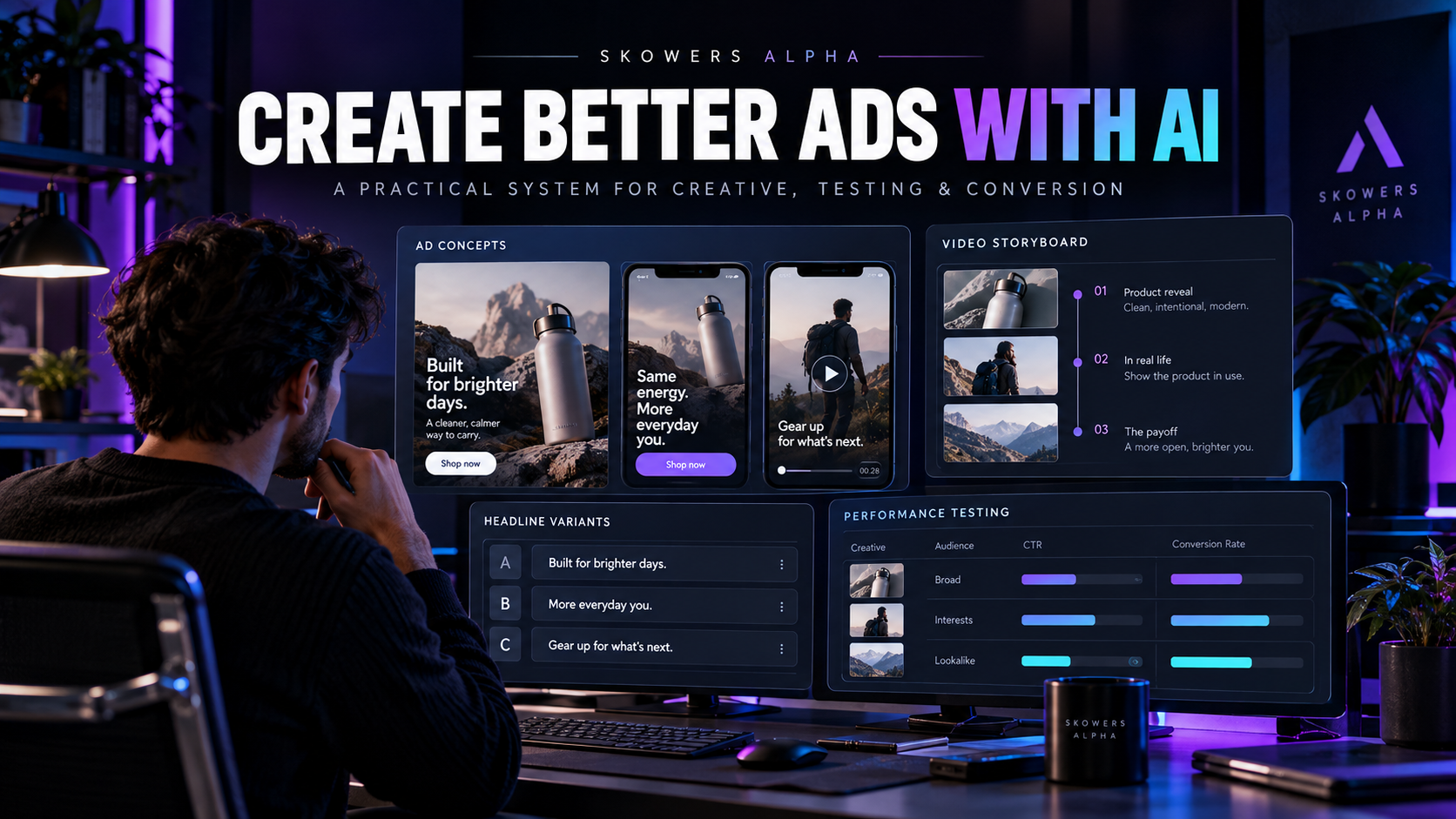
How to Create High-Converting Ads With AI: A Practical Creative Testing Guide
AI can generate a hundred ads quickly. That does not mean any of them will convert.
The ads that produce useful business results usually connect five things: a real customer problem, a credible offer, a clear creative angle, a matching landing page, and a controlled test. AI can accelerate each step, but it cannot replace customer knowledge, truthful claims, sound measurement, or human judgment.
This guide shows how to use AI to build a repeatable ad-creation system for Meta, Google, LinkedIn, TikTok, YouTube, and other channels without confusing production speed with performance.
Last reviewed October 29, 2026. Advertising platforms, policies, product features, and pricing change. Confirm current requirements before launching a campaign.
Skowers may earn a commission from partner links in this article at no additional cost to you. Recommendations are based on workflow fit. No tool can guarantee clicks, conversions, revenue, or return on ad spend.
What “High-Converting” Actually Means
A high-converting ad is not simply the creative with the highest click-through rate. It is an ad that attracts the right person, sets an accurate expectation, and moves that person toward a valuable action at a sustainable cost.
Before creating anything, define:
- Conversion: purchase, qualified lead, booked call, trial start, app install, or another measurable event
- Value: what one conversion is worth after refunds, fulfillment, and operating costs
- Audience: the specific people who have the problem and can act on the offer
- Constraint: the maximum acceptable cost per conversion
- Evidence: the proof supporting every important claim
If the business cannot define those five items, more creative volume will produce more noise rather than better advertising.
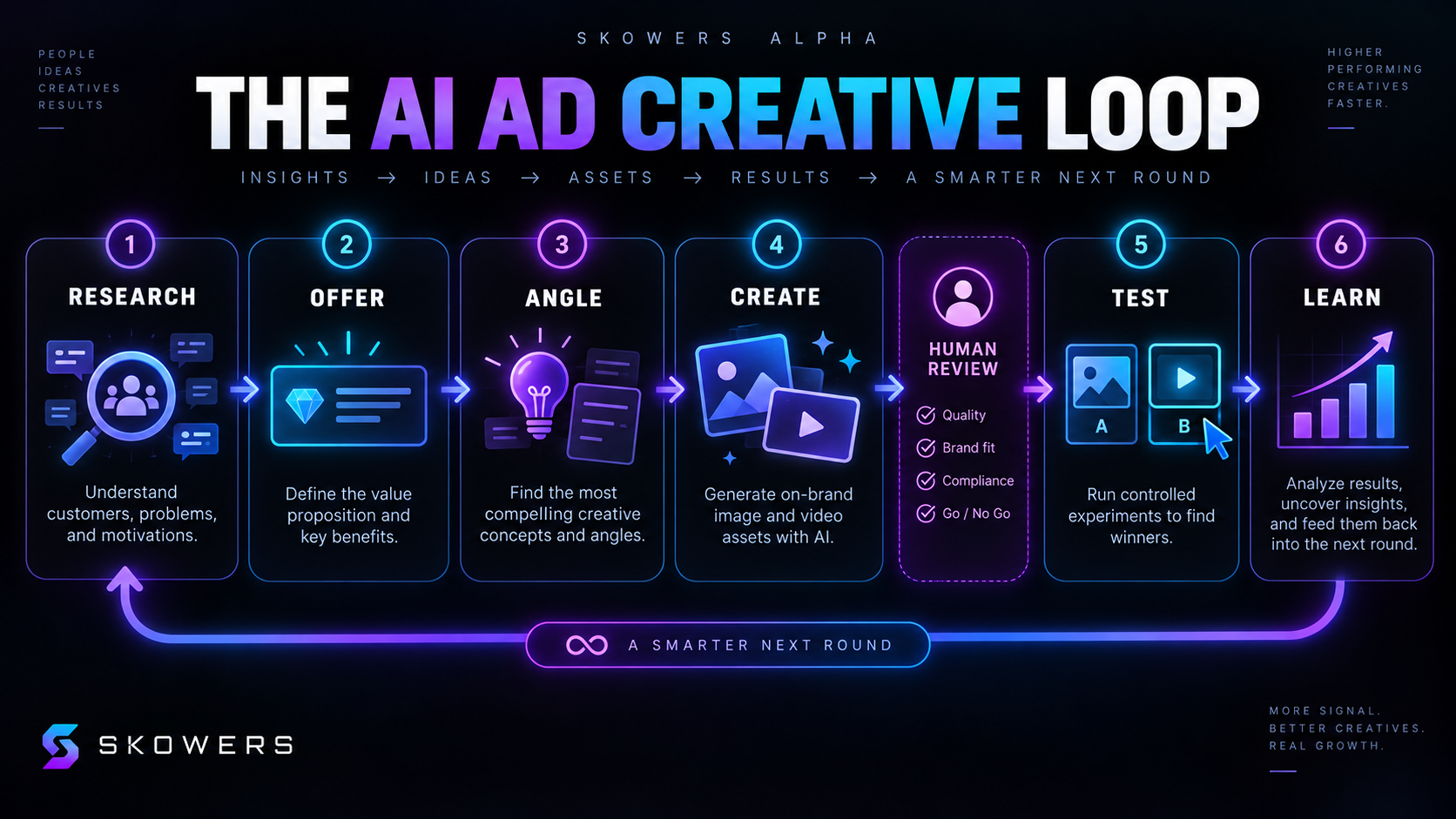
Step 1: Research the Customer Before Writing the Ad
Start with real customer language. Review approved sources such as sales-call notes, support tickets, product reviews, surveys, search queries, and frequently asked questions. Remove personal information before placing text into an AI tool.
Look for four signals:
- Trigger: what happened immediately before the customer started looking?
- Problem: what is difficult, expensive, slow, risky, or frustrating now?
- Desired outcome: what would a useful improvement look like?
- Objection: what makes the customer hesitate or distrust the offer?
Do not ask AI to invent a customer persona from nothing. Give it anonymized evidence and ask it to separate repeated patterns from assumptions.
copy:Customer-language research prompt|Analyze the approved, anonymized customer material below. Extract repeated triggers, problems, desired outcomes, objections, exact phrases, and unanswered questions. Separate direct evidence from inference. Do not invent demographics, motivations, quotes, or statistics. Source material: [PASTE APPROVED MATERIAL]
Step 2: Make the Offer Clear Enough to Advertise
Creative cannot rescue a vague offer. A useful offer tells the audience what they receive, why it matters, what reduces the risk, and what they should do next.
Use this structure:
For [specific audience], [product or service] helps [credible outcome] by [mechanism], with [proof or risk reducer].
Compare:
- Weak: “Transform your business with the future of AI.”
- Clearer: “Turn one approved webinar into five captioned social clips, ready for review in three business days.”
The second version gives the creative team something concrete to show and the buyer something concrete to evaluate.
copy:Offer clarity prompt|Act as a skeptical advertising strategist. Rewrite this offer for [AUDIENCE] using only the facts and evidence provided. Produce five clear variations. Each must state the problem, specific deliverable or outcome, mechanism, risk reducer, and next step. Flag every unsupported claim instead of strengthening it. Offer: [OFFER] Evidence: [EVIDENCE]
Step 3: Build Distinct Creative Angles
An angle is the reason a particular audience should care. Changing a few adjectives is not a new angle.
Build concepts around genuinely different frames:
- Problem angle: name the expensive or frustrating current state
- Outcome angle: show the practical after-state without exaggeration
- Proof angle: demonstrate the product, process, review, or measured result
- Objection angle: answer a real reason people hesitate
- Comparison angle: clarify a meaningful difference without misrepresenting competitors
- Use-case angle: show one specific job the product performs
Create three to five strong angles before creating dozens of visual variants. This makes the test easier to interpret.
Step 4: Create an Asset System, Not One Perfect Ad
Build modular assets that can work across placements:
- Product or service shown clearly
- Real use-case imagery
- Customer-problem visual
- Proof or demonstration sequence
- Short and long headlines
- Descriptions that add information rather than repeat the headline
- Brand marks in appropriate formats
- Square, horizontal, and vertical versions
- Short video openings and alternate first frames
Google's current responsive display guidance recommends high-quality images in horizontal, square, and vertical formats, warns against blurry or distorted imagery, and advises that assets should work in different combinations. It also recommends testing several ads with different messages and images rather than relying on one creative.
Museit can support original visual exploration, while Vista Social can help teams organize and schedule organic versions before committing paid budget. Use only assets you own or have permission to advertise.
Step 5: Review the Work Before Spending Money
AI-generated ads can look polished while containing serious errors. A human reviewer should check:
- Product names, prices, dates, limitations, and availability
- Claims against approved evidence
- Spelling, logos, colors, and brand voice
- Image rights, model releases, trademarks, and licensed media
- Synthetic people, voices, demonstrations, and required disclosure
- Platform policy and regulated-category restrictions
- Mobile readability and safe cropping
- Whether the call to action matches the destination
- Whether the landing page fulfills the promise in the ad
The Federal Trade Commission states that advertising must be truthful and not misleading, objective claims need support, endorsements must reflect honest experience, and material relationships should be disclosed. AI does not change those obligations.
Before spending budget, have a person check every claim, visual, and landing-page promise. Use the review checklist below to catch problems, then validate creative choices with a controlled live test.
copy:Pre-launch ad review|Review this ad as a brand editor, policy reviewer, and skeptical customer. Check claim support, offer clarity, audience fit, visual-text consistency, landing-page match, rights and disclosure risks, mobile readability, and possible misleading interpretations. Return: blockers, questions, suggested fixes, and a final human approval checklist. Ad: [AD] Evidence: [EVIDENCE] Landing page: [PAGE COPY]
Step 6: Test One Important Variable at a Time
If the audience, offer, format, headline, image, landing page, and bidding strategy all change at once, you will not know what caused the result.
Start with a clean question:
- Which angle performs better with the same audience and offer?
- Which opening frame holds attention longer for the same video?
- Which proof element improves qualified conversions?
- Which call to action produces more useful leads, not merely more clicks?
Keep the audience, offer, landing page, budget rules, and measurement window as consistent as practical while testing the chosen variable.
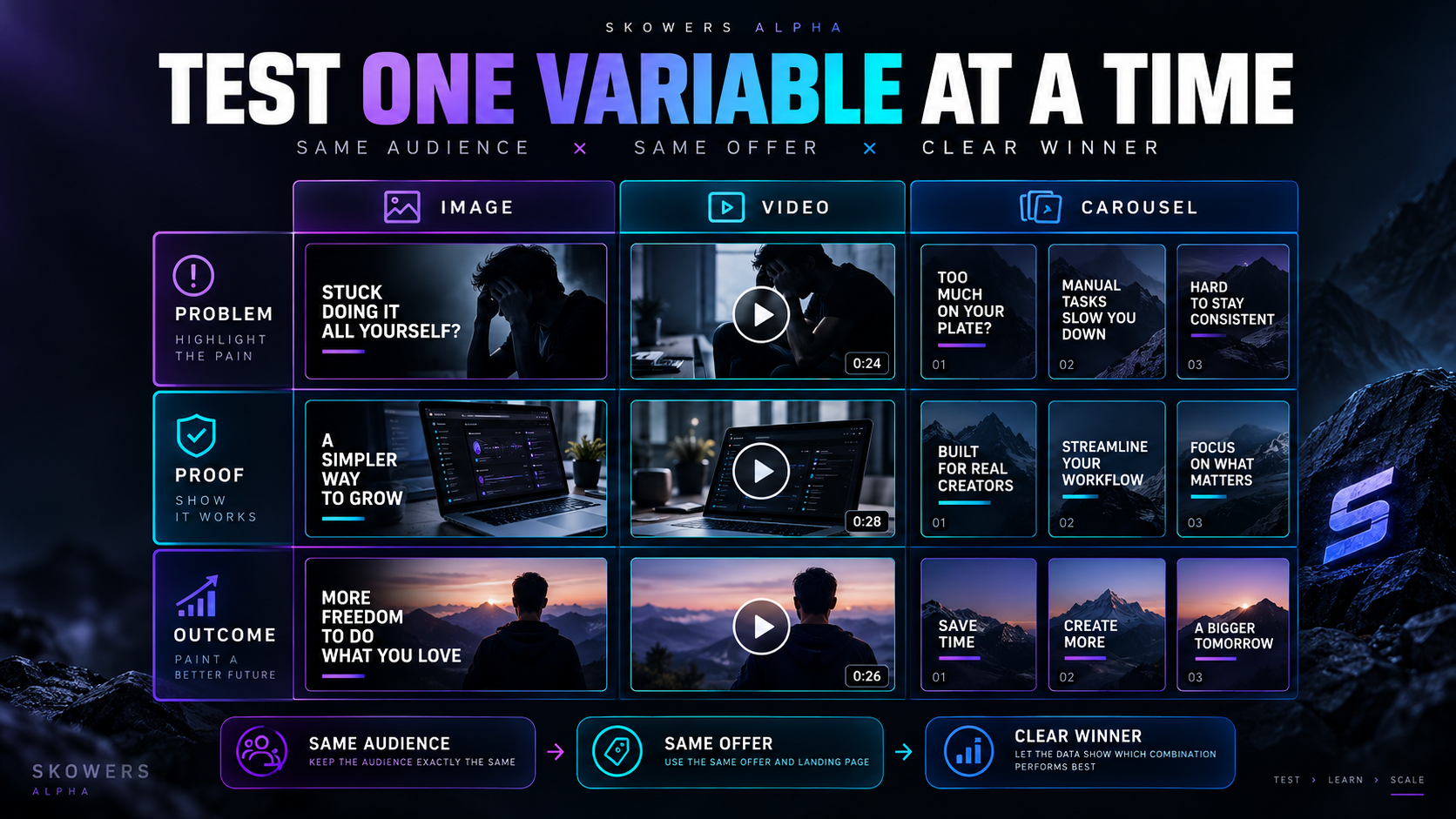
Do not stop a test because one ad is ahead after a few impressions. Decide the budget, minimum evidence, measurement window, and success metric before launch. Small advertisers may need to test larger creative differences because tiny copy changes can take too long to evaluate reliably.
Step 7: Measure the Whole Path
An ad can have a strong click-through rate and still lose money. Review the full chain:
- Attention: thumb-stop, view, or impression quality
- Engagement: click-through rate or qualified interaction
- Landing-page behavior: message match, speed, and next-step completion
- Conversion quality: purchase, qualified lead, activation, or retention
- Economics: acquisition cost, gross margin, refund rate, and lifetime value
Use the metric closest to business value as the final decision-maker. A cheap lead that never becomes a customer is not automatically a winning result.
A Practical 10-Ad Test Plan
Use one audience, one offer, and one destination page.
Round 1: Test the angle
- Ad 1–2: problem angle
- Ad 3–4: proof angle
- Ad 5–6: outcome angle
Use the same format where possible. Identify which angle produces the best qualified action, not merely the cheapest click.
Round 2: Test the format
- Ad 7: winning angle as a still image
- Ad 8: winning angle as a short video
- Ad 9: winning angle as a carousel or sequence
Round 3: Test the execution
- Ad 10: one focused improvement to the strongest combination, such as a clearer first frame, stronger demonstration, or more specific call to action
Document what changed and why. Archive weak ideas instead of repeatedly regenerating them with slightly different colors.
Qualified conversion: [EVENT] Audience: [AUDIENCE] Offer: [OFFER] Landing page: [URL OR COPY] Evidence approved for claims: [EVIDENCE] Variable being tested: [ONE VARIABLE] Control creative: [CONTROL] Variants: [VARIANTS] Budget and duration: [PLAN] Primary metric: [METRIC] Guardrail metrics: [METRICS] Decision rule set before launch: [RULE] Human approver: [OWNER]
Common AI Advertising Mistakes
Generating before researching
The output becomes generic because the model has no customer evidence.
Testing cosmetic variations
Ten background colors are not ten useful hypotheses. Test angles, demonstrations, offers, and proof.
Optimizing only for clicks
Clickbait can raise traffic while lowering trust and conversion quality.
Using fabricated proof
Never generate testimonials, customer counts, expert endorsements, before-and-after results, or product demonstrations that did not happen.
Ignoring the landing page
The ad and destination should describe the same offer, audience, terms, and next step. Google explicitly recommends a relevant landing page that reflects the ad message.
Scaling before learning
More budget magnifies unclear positioning, tracking mistakes, weak fulfillment, and unsupported claims.
Frequently Asked Questions
Can AI create high-converting ads automatically?
AI can accelerate research synthesis, concept development, copy variants, images, storyboards, resizing, and analysis. It cannot guarantee performance. Conversion depends on the audience, offer, product, competition, landing page, measurement, budget, and execution.
What is the best AI tool for creating ads?
The best tool depends on the bottleneck. Adcreative focuses on producing variants, mktg.ai connects creative with campaign performance, Vista Social supports planning and organic distribution, and Museit supports visual ideation. Test tools against a real workflow before subscribing.
How many ad variations should I create?
Create enough genuinely different concepts to test a clear hypothesis. Three strong angles with a few executions each are usually more informative than dozens of near-duplicates. Platform requirements, budget, audience size, and conversion volume affect the right number.
Should AI-generated ads be disclosed?
Follow the rules of the platform, jurisdiction, category, and media type. Disclose synthetic or altered media when required and whenever omission could mislead. Paid endorsements and other material relationships also need clear disclosure.
What should small businesses test first?
Test the largest uncertainty first: audience, offer, angle, proof, or landing-page message. Do not begin with tiny stylistic details if the core reason to buy is still unclear.
Build the Next Ad From Evidence
The best use of AI in advertising is not endless generation. It is a tighter learning loop: understand the customer, sharpen the offer, create distinct hypotheses, review carefully, run controlled tests, and feed measured results into the next round.
Use the Skowers Prompt Library to build reusable research and creative briefs, explore Automation Templates for approved production handoffs, and track software trials in the Dashboard before adding another paid tool.
For platform-specific guidance, review Google's responsive display ad best practices and the FTC's advertising and marketing guidance.
AI Tools for Ad Creative and Testing




Related Articles
Continue Your Research