
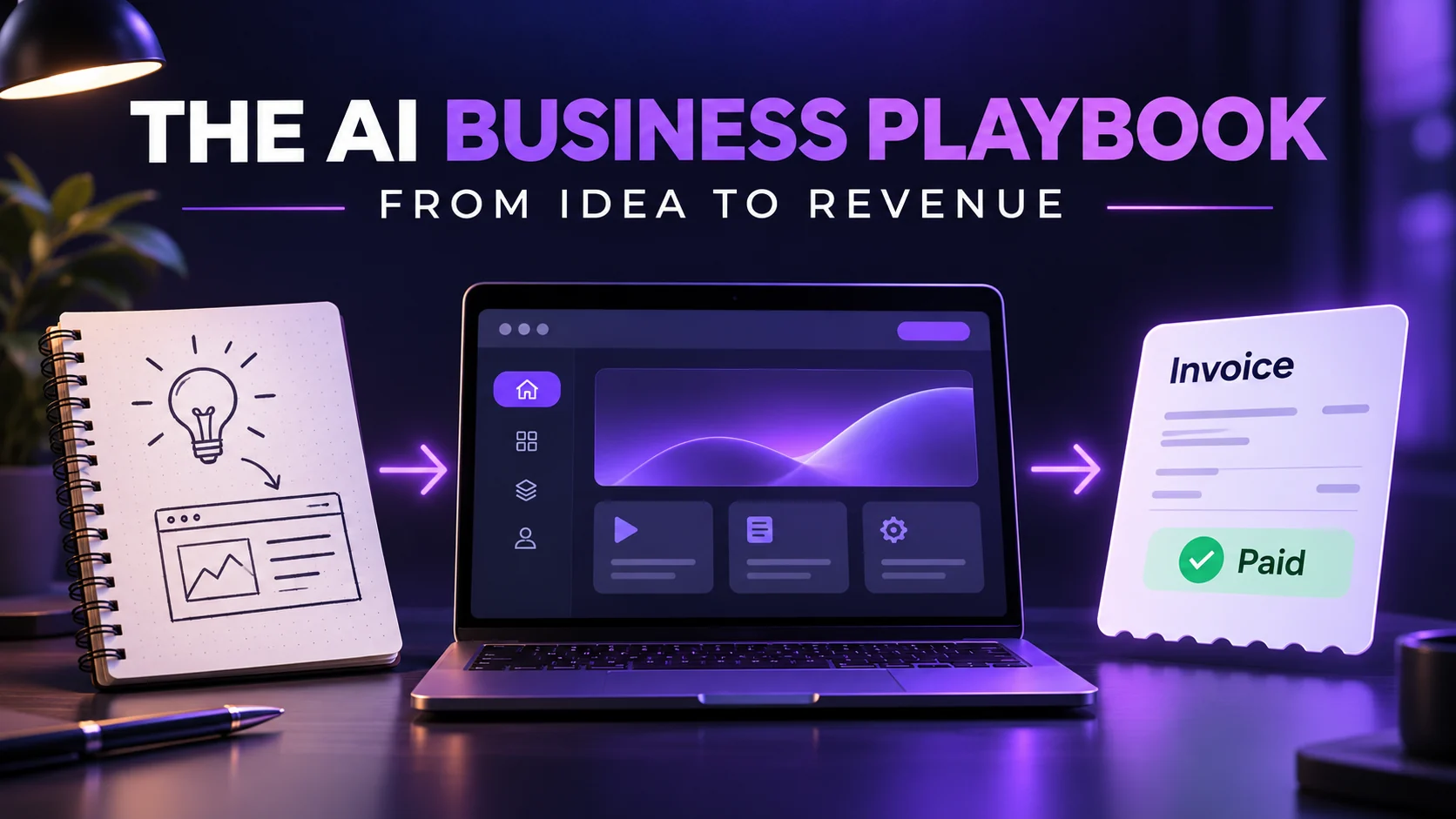
The AI Business Playbook: From Idea to Revenue
An AI tool can give you a business idea in seconds. It cannot tell you whether someone will pay for it. That answer comes from a specific customer, a problem they already recognize, an offer they understand, and a way to buy.
This playbook takes you from a rough idea to your first revenue. You can use it for a service, a small software product, or a digital offer. Move to the next stage only when the current one produces evidence. You do not need every tool mentioned here; choose the ones that remove a real bottleneck.
Last reviewed November 9, 2026. Product features and partner terms can change. Check each tool's current plan before committing.
Skowers may earn a commission when you use partner links in this guide, at no extra cost to you. The steps also work with tools you already own.
The route in one view
Stage
1. Validate
What you produce
A one-sentence problem and five customer conversations
Proof you can move on
People describe the problem in their own words.
Stage
2. Offer
What you produce
One outcome, scope, price, and next step
Proof you can move on
A prospect understands the offer without a long explanation.
Stage
3. Launch
What you produce
A working page and a way to contact or pay you
Proof you can move on
A stranger can complete the main action on a phone.
Stage
4. Reach
What you produce
A small, relevant prospect list and useful outreach
Proof you can move on
People reply, book, or ask a buying question.
Stage
5. Deliver
What you produce
The promised result and a clean invoice
Proof you can move on
A customer pays and can explain the value received.
Stage
6. Improve
What you produce
A record of objections, costs, and repeatable work
Proof you can move on
You know what to change before spending more.
| Stage | What you produce | Proof you can move on |
|---|---|---|
| 1. Validate | A one-sentence problem and five customer conversations | People describe the problem in their own words. |
| 2. Offer | One outcome, scope, price, and next step | A prospect understands the offer without a long explanation. |
| 3. Launch | A working page and a way to contact or pay you | A stranger can complete the main action on a phone. |
| 4. Reach | A small, relevant prospect list and useful outreach | People reply, book, or ask a buying question. |
| 5. Deliver | The promised result and a clean invoice | A customer pays and can explain the value received. |
| 6. Improve | A record of objections, costs, and repeatable work | You know what to change before spending more. |
1. Start with a problem you can verify
Write down who has the problem, what triggers it, and what it costs them in time, money, or missed opportunity. “AI marketing for everyone” is too broad. “Local service firms lose inquiries because nobody follows up after hours” gives you someone to talk to and a result to test.
Have five short conversations with people who might buy. Ask what happened the last time the problem appeared, what they tried, and what a useful outcome would look like. Avoid asking whether they “like” your idea. Compliments are easy; details about current behavior are more useful.
With permission, Fireflies.ai can capture a customer call so you can review the actual wording later. Check the transcript before quoting or acting on it, and follow the recording rules that apply to your calls. If your idea depends on public market information, Parallel AI can help organize a research workflow, but verify claims against their sources.

Decision gate: If people cannot describe the problem or already solve it cheaply, narrow the audience or change the offer before building a full product.
2. Turn the problem into one offer
Complete this sentence: “I help [specific buyer] get [observable result] within [time or scope] by [method].” Then add a starting price or a clear request for a quote, what is included, what is excluded, and what happens after someone says yes.
For a service, sell a small paid pilot you can deliver well. For software, define one job the first version must complete. A first offer could be “We set up a follow-up process for missed website inquiries in 10 business days,” rather than a promise to transform all sales operations.
Send the offer to three interviewees. Ask them to explain it back to you. Rewrite any part they misunderstand. The goal is a buying decision, not a clever slogan.
Useful prompt: “Act as a skeptical buyer in [industry]. Read this offer. List what you think you will receive, what remains unclear, the risks you would ask about, and the one question you would need answered before buying. Do not invent features or guarantees. Offer: [paste offer].”
3. Publish the smallest page that can sell it
Your first page needs a clear headline, the problem, the promised outcome, what is included, proof you can honestly show, a price or pricing path, and one call to action. Put contact details and basic policies where buyers can find them. A working page with a real next step is more valuable than a polished page with a dead form.
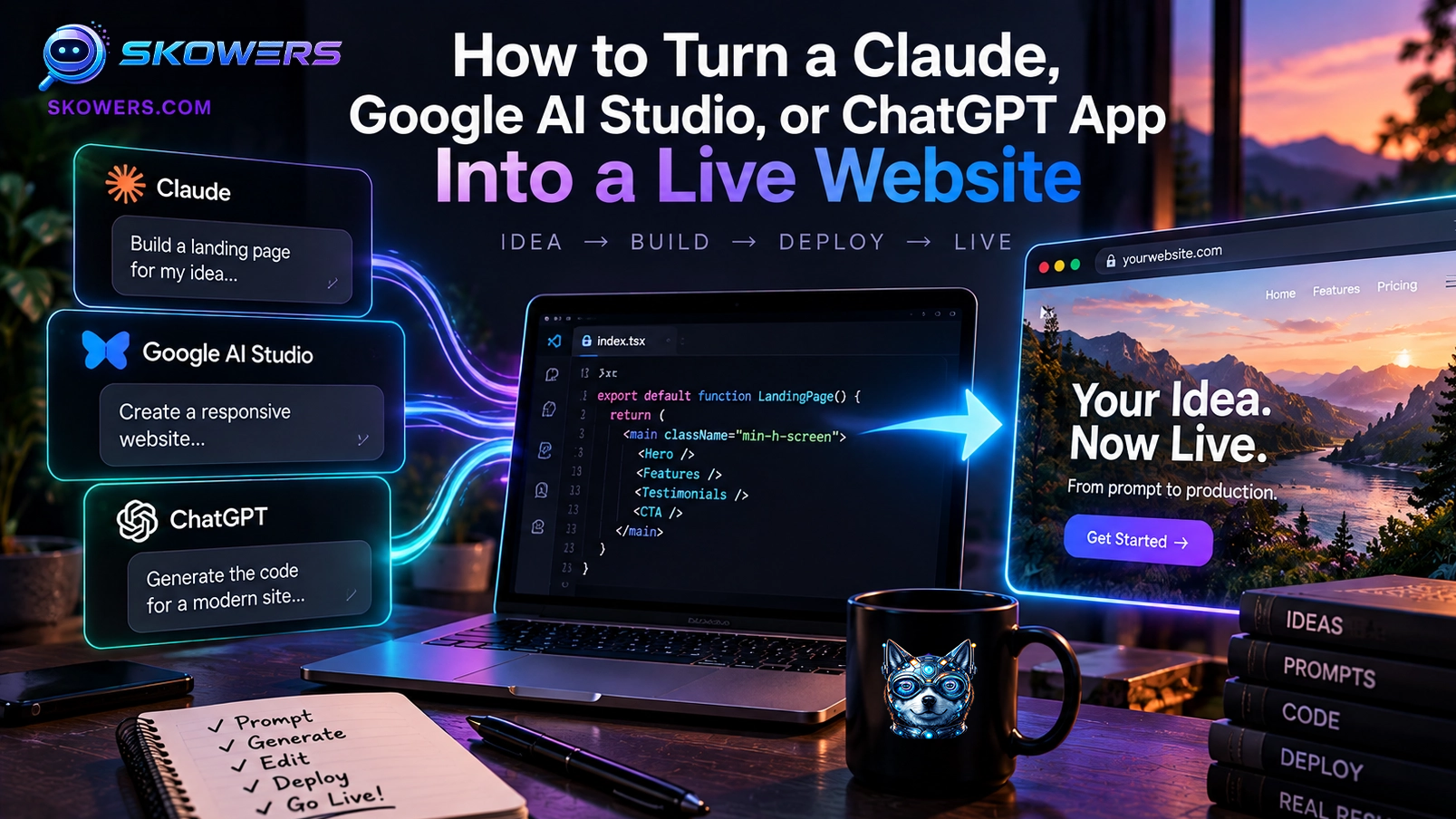
If you already have project files, Netlify can publish a finished static site or connect a repository for repeatable deployments. Use the AI app to live website guide if your page started in Claude, Google AI Studio, or ChatGPT and still lives in a preview. Test the live URL on a phone and send one real form submission before sharing it.
If writing content is the bottleneck, RankBolt can help research a small topic cluster and draft supporting articles. Start with questions buyers actually asked in your interviews. Edit every draft for accuracy and add examples you can stand behind. Do this after the offer page works; an article calendar cannot repair an unclear offer.
4. Reach a few people who fit
Choose one acquisition route for the first two weeks. A local web design agency might find firms with missing sites. A B2B service might work from a carefully researched list. A creator with an existing audience might publish a short demonstration and ask for replies.
For the local agency example, Grape Leads can filter businesses by location and website status. Verify every record before outreach; a missing website field does not prove a business has no website. If social posting is already where your customers engage, SocialDesk can help schedule a small run of posts and manage replies. Read every comment and message as feedback, not just an engagement number.
Do not send a generic blast. Pick 20 plausible prospects, check why each might care, and write a short message that offers one relevant observation and a low-pressure next step. Respect opt-outs and applicable outreach rules.
First outreach note: “I noticed [specific observation]. We help [type of business] achieve [clear outcome]. If this is a current priority, I can send a short example of what I would change for [their situation]. Interested?”

5. Make payment and delivery easy to trust
Before you take money, put the scope, price, timeline, revision or support terms, and refund or cancellation terms in writing. Never let AI invent a promise you cannot fulfill. If the work involves sensitive customer data, decide what you need to collect and who can access it.
For a service or freelance offer, BillingNow can help create an estimate or invoice and track whether it has been paid. Review tax settings, totals, client details, and payment instructions yourself. Record the actual payment separately from a sent invoice: revenue is money earned from customers, not a proposal in your pipeline.
Deliver the smallest promised result, then ask what changed for the customer. A specific outcome and a genuine testimonial, with permission, will help the next sale more than a collection of AI-generated claims.
6. Use the first sale to choose the next experiment
Track a few numbers in one sheet: prospects contacted, meaningful replies, calls, proposals, paid customers, revenue collected, delivery hours, direct costs, and refund requests. Review the customer's exact objections alongside those numbers. A sale that takes 40 hours to deliver at a 10-hour price is evidence that your scope or price needs work.
If you bring in a collaborator, Team Pulse can keep the next project, owner, and deadline visible. Add an automation tool such as Parallel AI only after you can describe the task and review its output. Early automation should save time on a process that already works.
At the end of two weeks, choose one change: a narrower buyer, a clearer offer, a different channel, a better handoff, or a higher price. Keep the rest steady so you can tell what helped.
A realistic 14-day starting plan
- Days 1–3: Define one buyer and interview five people. Write down their language and current workarounds.
- Days 4–5: Draft one offer with scope, price, and next step. Ask three people to explain it back.
- Days 6–7: Publish a simple page and test every link, form, and mobile view.
- Days 8–11: Reach 20 researched prospects or publish a focused series to an existing audience. Follow up thoughtfully.
- Days 12–14: Run calls, propose a small paid pilot, invoice clearly, and record what buyers actually did.
The dates are a planning tool, not a promise of revenue. If interviews reveal a weak problem, spend more time on validation. If buyers are ready, take the paid pilot before adding more features.
Frequently asked questions
How much should I spend on AI tools before my first sale?
As little as possible. Use what you have, start with free tiers or trials when appropriate, and pay for a tool only when it solves a measured bottleneck. Your first customer evidence matters more than your stack.
Do I need to build an app to start an AI business?
No. A service with a clear deliverable can be a faster way to test demand. Build software when you understand the recurring job, the buyer, and the limits of manual delivery.
Which metric matters first?
For an early offer, look for qualified conversations and paid commitments. Visits, post impressions, and generated leads help only if they move people toward a real purchase.
When should I automate outreach or delivery?
After you have a message or delivery process that works by hand. Keep a person reviewing claims, customer data, and anything that sends or bills on your behalf.
Tools for the First Sales Loop



Related Articles
Continue Your Research