
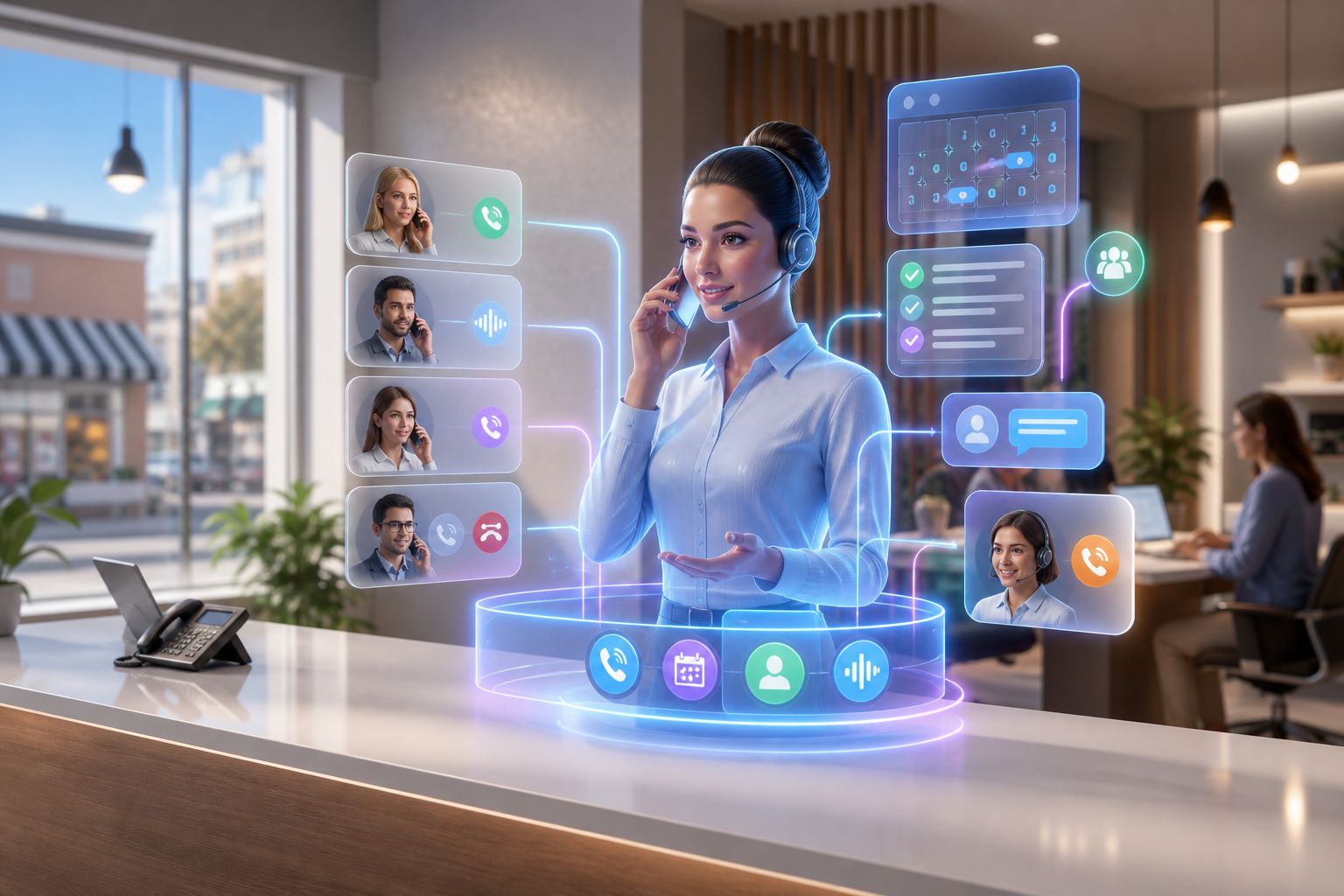
AI Receptionists Are Becoming the New Front Desk for Small Business
Listen: AI Receptionists Are Becoming the New Front Desk for Small Business
The phone is still one of the highest-intent channels in small business.
People call when they need a quote, appointment, repair, consultation, table, estimate, refund, or urgent answer. They may also call because they are tired of filling out forms and waiting for a reply.
That is why missed calls still hurt.
A missed call can become a lost customer. A slow callback can send a buyer to the next provider. A full voicemail box can make a business look disorganized even when the work itself is excellent.
AI receptionists and AI phone agents are becoming a practical answer to that problem.
They are not only chatbots with a voice. The better systems can answer calls, understand intent, ask qualifying questions, book appointments, send follow-up texts, route urgent issues, and create records in the tools a business already uses.
For local service businesses, clinics, agencies, contractors, salons, repair shops, consultants, real estate teams, and appointment-based companies, this is becoming one of the most useful AI categories to watch.
Why AI Phone Agents Matter Now
Voice AI has moved quickly.
OpenAI's Realtime API made it easier for developers to build low-latency speech experiences. Google Cloud has continued to invest in conversational agents and contact center AI. Twilio has also expanded AI features around customer conversations, call analysis, and communication workflows.
The result is simple.
Voice automation is becoming more natural, faster to deploy, and more useful for everyday business calls.
That does not mean every business should replace humans at the front desk.
It means the first response layer is changing.
An AI receptionist can cover nights, weekends, lunch breaks, overflow calls, after-hours inquiries, and repetitive questions. A human can still handle sensitive issues, relationship-heavy calls, complex complaints, and judgment calls.
The best version is not AI instead of people.
It is AI catching the work that used to fall through the cracks.
What An AI Receptionist Actually Does
A useful AI receptionist should handle more than greetings.
The job is to turn a call into the right next step.
That can include:
- Answering common questions
- Capturing name, phone number, email, and reason for calling
- Booking appointments
- Confirming availability
- Sending SMS follow-ups
- Routing urgent calls to a human
- Qualifying service requests
- Creating CRM or calendar records
- Summarizing the conversation
- Flagging missed revenue opportunities
The value is not only the voice.
The value is the handoff.
If the AI answers a call but does not create a useful record, the business still has to do cleanup later. If it books a meeting but does not understand availability rules, the team gets scheduling problems. If it handles a frustrated customer without escalation rules, the business may lose trust.
A good AI phone agent should make the team calmer, not busier.
Best-Fit Businesses
AI receptionists work best where calls are frequent, intent is clear, and the next step can be structured.
Strong fits include:
- Home services
- Dental and medical offices
- Salons and spas
- Real estate teams
- Legal intake
- Insurance agencies
- Restaurants and hospitality
- Auto repair
- Local contractors
- Coaching and consulting businesses
The common pattern is simple.
The caller usually wants one of a few outcomes.
They want to book, ask, reschedule, confirm, request a quote, report a problem, or speak to the right person.
If those paths can be written down, an AI receptionist can usually help.
When A Human Still Matters
Some calls should not be automated fully.
Sensitive health questions, legal advice, billing disputes, angry customers, complex refunds, safety concerns, and high-value accounts need human judgment.
That does not make AI useless.
It means the AI should identify those calls quickly and route them to the right person.
The safest setup is clear.
Let AI answer and collect context.
Let humans decide when stakes are high.
This keeps the customer from waiting in silence while protecting trust.
What To Test In The First Week
Do not judge an AI receptionist from a polished demo.
Judge it from your real calls.
Start with one workflow:
- New appointment request
- Missed call callback
- After-hours inquiry
- Quote request
- Existing customer reschedule
- FAQ call
Write the exact outcome you want before testing.
For example:
The AI should answer after hours, ask what service the caller needs, capture contact details, explain the next available appointment window, send a confirmation text, and create a note for the team.
That is testable.
If you cannot describe the workflow, the tool cannot be evaluated fairly.
Buyer Checklist For AI Receptionist Tools
Before choosing an AI phone agent, check the basics.
- Does it sound natural enough for your customers?
- Can it handle interruptions?
- Can it transfer to a human?
- Can it book appointments inside your calendar?
- Can it send SMS follow-ups?
- Can it create notes in your CRM or inbox?
- Can you review call recordings or transcripts?
- Can you control what it is allowed to say?
- Can you set business hours and escalation rules?
- Can it handle multiple locations or service areas?
- Does it disclose AI use when required?
- Does pricing make sense for your call volume?
Do not skip the review controls.
The voice may impress you first, but governance decides whether the system survives real customers.
Common Mistakes To Avoid
The first mistake is letting the AI answer too much too soon.
Start with low-risk calls. Expand only after reviewing transcripts and outcomes.
The second mistake is giving the AI weak instructions.
If your policies, pricing, service areas, and booking rules are unclear, the AI will sound confident while creating confusion.
The third mistake is failing to connect the call to action.
A great call summary is not enough if nobody follows up.
The fourth mistake is ignoring tone.
Some businesses need warm and conversational. Others need crisp and professional. A law office, roofing company, med spa, and SaaS support desk should not all sound the same.
The fifth mistake is treating AI as a replacement for service quality.
If the business does not follow through after the call, the AI cannot save the experience.
The Best First Use Cases
AI receptionists usually prove value fastest in a few places.
Missed Call Recovery
When a team misses a call, the AI can respond quickly, capture intent, and send a follow-up. This protects revenue without requiring someone to monitor the phone all day.
Appointment Booking
If the business runs on calendars, an AI receptionist can guide callers into available times and reduce back-and-forth.
Lead Qualification
The AI can ask simple questions about budget, service need, location, timeline, and urgency before handing the lead to a human.
After-Hours Coverage
Many high-intent calls happen outside normal business hours. AI can answer instead of sending callers to voicemail.
Support Triage
The AI can separate routine questions from urgent issues, then route the right calls to the right person.
These use cases are practical because they have clear paths.
Clear paths are where AI is strongest.
What This Means For Local SEO And Conversion
AI receptionists also connect to local search.
A customer may find a business through Google, ChatGPT, Apple Maps, Yelp, social media, or a referral. The discovery channel matters less if the call goes unanswered.
Local SEO brings demand to the door.
Phone coverage helps convert it.
That is why AI receptionist software, AI answering services, and AI appointment booking tools are becoming part of the marketing stack, not only the operations stack.
For service businesses, the call is often the conversion event.
If AI helps answer more calls, qualify more leads, and book more appointments, it supports both growth and customer experience.
How To Compare AI Receptionists
Use a simple scorecard.
Call quality.
Booking accuracy.
Escalation reliability.
CRM or calendar integration.
Transcript and review tools.
Pricing by call volume.
Control over answers.
Customer comfort.
The winner is not always the most advanced voice.
The winner is the tool that handles your most common calls correctly and hands the rest to a person.
A Simple Setup Plan
Start with your last 25 real calls.
Sort them into categories. New lead, appointment, reschedule, complaint, support, billing, vendor, spam, urgent issue, general question.
Pick the category that is common and low risk.
Write the approved answer and next step.
Connect only the tools required for that workflow.
Run test calls with your team.
Review every transcript for the first week.
Adjust instructions.
Only then expand to more call types.
This is slower than turning everything on at once, but it protects the customer experience.
The Bottom Line
AI receptionists are becoming one of the most practical AI tools for small businesses.
They help answer calls, recover missed leads, book appointments, qualify requests, and route important conversations to humans.
The best use is not replacing every front-desk task.
The best use is giving customers a faster first response while giving the team better context.
If your business wins or loses money through phone calls, AI phone agents are worth testing.
Start with one workflow. Review the calls. Keep humans in the loop. Let the system earn more responsibility over time.
Related Articles
Continue Your Research