
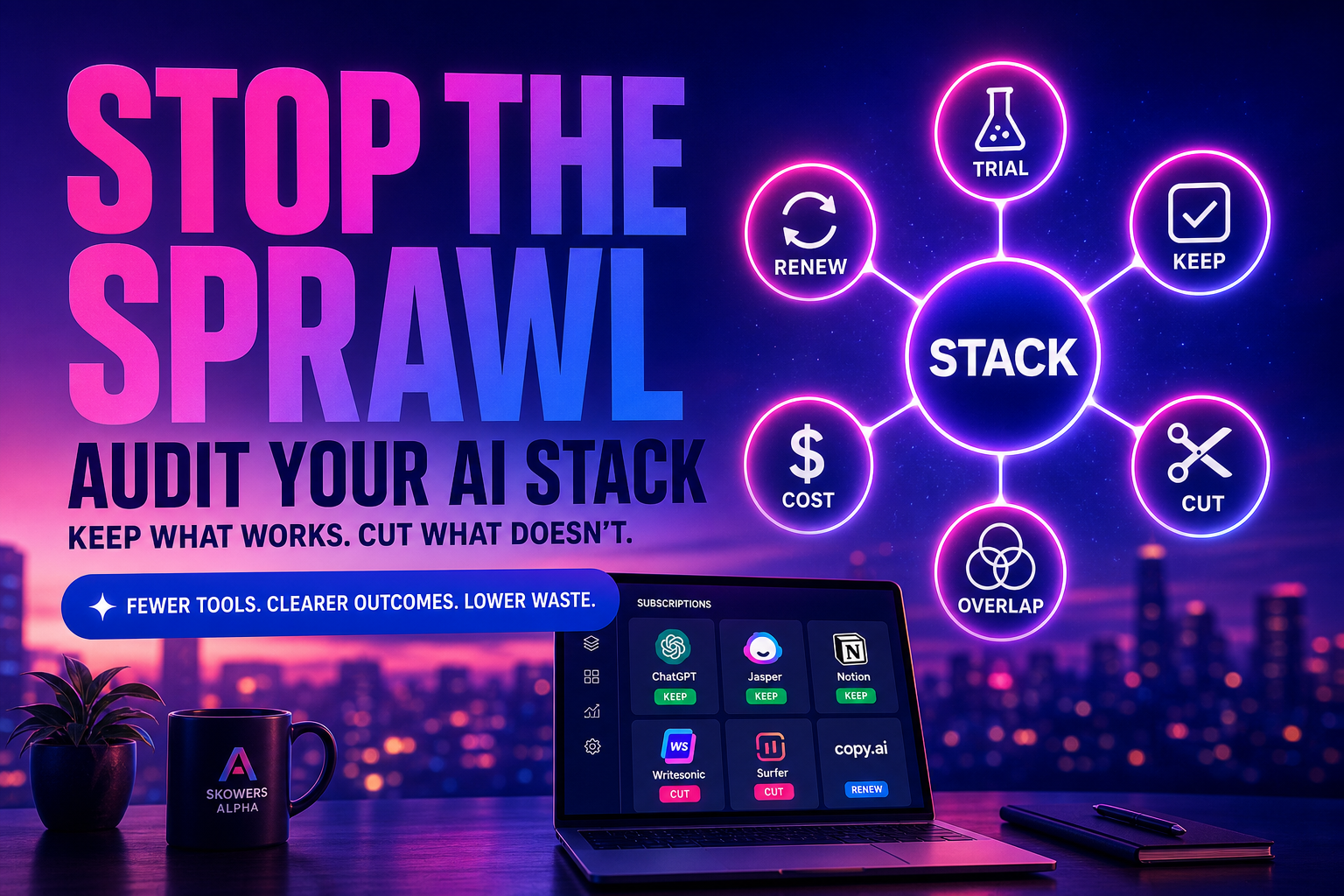
AI Tool Sprawl Is Quietly Draining Your Budget. Here's the Stack Audit That Fixes It
Listen: AI Tool Sprawl Is Quietly Draining Your Budget. Here's the Stack Audit That Fixes It
The average founder does not have an AI strategy problem.
They have a browser-tab problem.
Twelve logins. Five “AI writing” tools. Three meeting notetakers. Two CRMs that both claim to “close deals.” A calendar full of free-trial end dates nobody tracked. Each app looked smart in isolation. Together they create AI tool sprawl, the quiet tax of overlapping subscriptions, half-finished onboarding, and workflows that never settle.
This is the piece most “best AI tools” lists skip. Skowers exists to help you find software worth testing. This article is about the next skill, knowing what to keep, what to cut, and what never deserved a card in the first place.
If you already feel the drag from decision fatigue, renewals you forgot, and tools the team ignores, this is your afternoon reset.
What AI Tool Sprawl Actually Is
Sprawl is not “using AI.” Sprawl is owning redundant capability without a single owner, outcome, or review date.
It usually looks like this.
- You add a tool because a launch video was impressive.
- You start the free trial “to explore.”
- You never run one real workflow end-to-end.
- The trial ends or auto-converts.
- You keep the login “just in case.”
- Next quarter you buy another tool in the same category.
The cost is not only money. Sprawl burns attention, training time, integration glue, and trust, because teammates stop knowing which system is the source of truth.
Why Sprawl Got Worse in 2026
Three forces stacked.
1. Category explosion. Every job now has five AI options for support, SEO, video, outreach, coding, research, and decks.
2. Trial culture. Free trials are useful until they become a habit of collecting instead of evaluating.
3. Feature overlap marketing. Tools advertise the same five promises like “AI agent,” “automate outreach,” “write content,” “summarize meetings,” and “save time.” Without a stack map, you buy the same promise twice.
Skowers’ directory, Power Stacks, and trial tracking exist because discovery without discipline creates clutter. Discovery with a keep, cut, and trial rule creates leverage.
The Stack Audit (One Afternoon, Not a Retreat)
Block 90 minutes. Open a blank note. List every AI or SaaS tool you pay for, trial, or “might renew.”
For each tool, answer five questions.
1. What job does this own?
Write one sentence. Not “marketing.” Something like “Turns long recordings into captioned short clips” or “Books meetings from WhatsApp and website chat.”
If you cannot name the job, the tool is a candidate for cut.
2. What is the weekly proof it worked?
Examples that count.
- Tickets resolved
- Posts published
- Meetings booked
- Deploys shipped
- Reports that changed a decision
Vanity logins do not count.
3. What else in the stack does the same job?
Mark overlaps. Two notetakers. Two SEO writers. Two “AI SDRs.” Overlap is where money hides.
4. Who owns it?
No owner means zombie software. Assign a human or schedule the cancel.
5. Keep, cut, or re-trial?
- Keep if it has a clear job, weekly proof, one owner, and weak overlap.
- Cut if unused, redundant, or too expensive for the proof.
- Re-trial only if the job is real but you never tested it on a live workflow.
A Practical Keep Framework That Favors Outcomes Over Features
When two tools look similar, score them on outcomes.
- Time to first win. Can a teammate get value in under an hour?
- Switching cost. How painful is leaving later?
- Integration load. Does it need five brittle zaps to matter?
- Team adoption. Do people open it without reminders?
- Compounding. Does last week’s work make this week easier?
A tool that compounds with templates, memory, CRM history, brand kits, and agent rules usually beats a shiny one-off generator.
Where Directory Tools Fit a Lean Stack Without Collecting Everything
You do not need every category. You need coverage without clones.
Operations and automation
If handoffs are the bottleneck, one durable automation layer beats five “AI agents” that do not talk to each other. n8n is built for connecting systems so work moves overnight without copy-paste.
Building and shipping software
If product speed is the constraint, prefer one serious build environment over a pile of half-used coding assistants. Cursor is for teams that ship features and fix bugs with agents inside a real codebase, not for collecting prompts in a notes app.
Visibility and decisions
Sprawl thrives when nobody sees cost and performance together. Analytics hubs like Databox help when metrics live in ten tabs and renewals surprise you.
Sales follow-through
If pipeline tools multiply because “this one has AI,” pick the system that owns calls, follow-ups, and next actions. is an example of consolidating sales motion instead of adding another side CRM.
Support channels
Chat widgets stack fast. Choose one governed path for customer conversations. Tools in the Typewise, Algomo, and SleekFlow lane exist so you stop running three inboxes that all “answer FAQs.”
Content and SEO
Content tools proliferate because every app promises “rank and write.” Prefer a clear content operating system over five writers. Options like BabyLoveGrowth matter when publishing and visibility are the actual gap, not another blank-page chatbot.
Hosting and shipping web surfaces
Marketing sites and app frontends often accumulate random hosts and page builders. Netlify is the “ship from git to preview to production” pattern that reduces DIY hosting sprawl for many teams.
The point is not “buy these seven.” The point is one strong tool per critical job, ideally wired into a Power Stack instead of a junk drawer.
Free Trials Without Sprawl
Trials are how you learn. They become sprawl when you do the following.
- Start three trials in the same category the same week
- Never define a success test
- Miss the cancel date
- Keep access “for later”
A cleaner trial protocol looks like this.
- One category at a time. Compare two tools max.
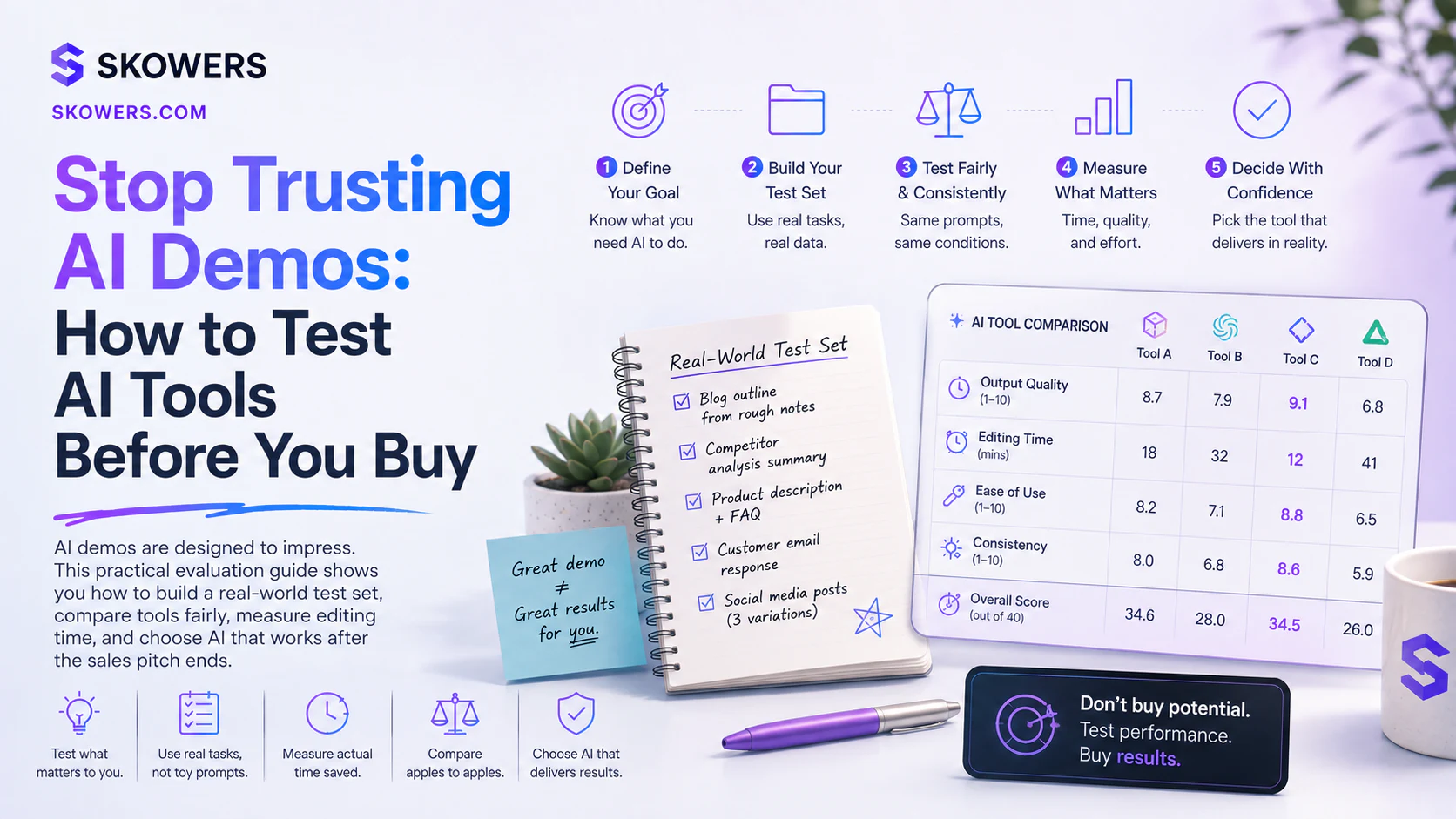
- One real workflow. Use your data, your customer, and your repo, not the demo dataset.
- A written pass or fail. Example. “If we cannot publish three Shorts from one long video in 90 minutes, we fail this tool.”
- A tracked end date. Use Skowers’ trial tracker and dashboard habit so renewals are deliberate.
- A keep decision in writing. Screenshot the proof. Then subscribe or cancel.
The 80/20 Stack Pattern Most Teams Need
Most small teams stabilize around a thin core.
- Build and ship (IDE or product surface)
- Automate (workflow glue)
- Talk to customers (support and CRM)
- Create (one content, video, or deck lane, not five)
- Measure (one dashboard habit)
Everything else must earn a seat by replacing a human bottleneck, not by winning a homepage demo.
Power Stacks on Discover are useful here because they already group tools by outcome like ship, outreach, support, and SEO instead of by hype word. Use them as starting maps, then prune.
A 7-Day Sprawl Cleanup Plan
Day 1. Export a full tool list with monthly cost and renew date. Day 2. Tag each as keep, cut, or re-trial. Cancel obvious zombies. Day 3. Resolve one overlap category (example meeting notes). Pick a winner. Day 4. Resolve a second overlap (example writing assistants). Day 5. Wire one automation so two keepers actually talk (n8n or your existing glue). Day 6. Put active trials into a tracker with pass or fail notes. Day 7. Write a one-page stack policy covering categories you allow, max tools per category, and who can add software.
That last page is the anti-sprawl insurance policy.
Why This Topic Matters for Readers and for Search
People are not only searching “best AI tools 2026.” They are searching for things like these.
- how to choose AI tools for small business
- cancel unused SaaS subscriptions
- AI stack for startups
- free trial AI tools worth keeping
- reduce software costs AI
Helping readers audit is as valuable as helping them discover. It builds trust. You are not trying to fill their card with every affiliate link. You are trying to leave them with a stack that works.
Bottom Line
AI tool sprawl feels like progress because every install is a hit of novelty. Real progress is fewer tools, clearer jobs, and weekly proof.
Run the audit. Kill overlaps. Trial with a pass or fail. Keep what compounds.
Then, and only then, go back to the directory for the next missing piece. Discovery is powerful when your stack has empty slots on purpose, not because you forgot to cancel last quarter.
Related Articles


Continue Your Research