Close AI Explained: The Sales CRM That Calls, Follows Up, and Keeps Your Pipeline Moving

Close is a sales CRM built for teams that spend their day prospecting, following up, qualifying leads, and moving opportunities toward a decision. Instead of making representatives jump between a database, dialer, email sequencer, texting app, meeting tool, and note-taking system, Close brings those activities into one sales workspace.
The product is commonly described as Close AI because artificial intelligence now plays a meaningful role in the platform. The company and core product are officially called or . Its built-in AI sales teammate is Chloe.
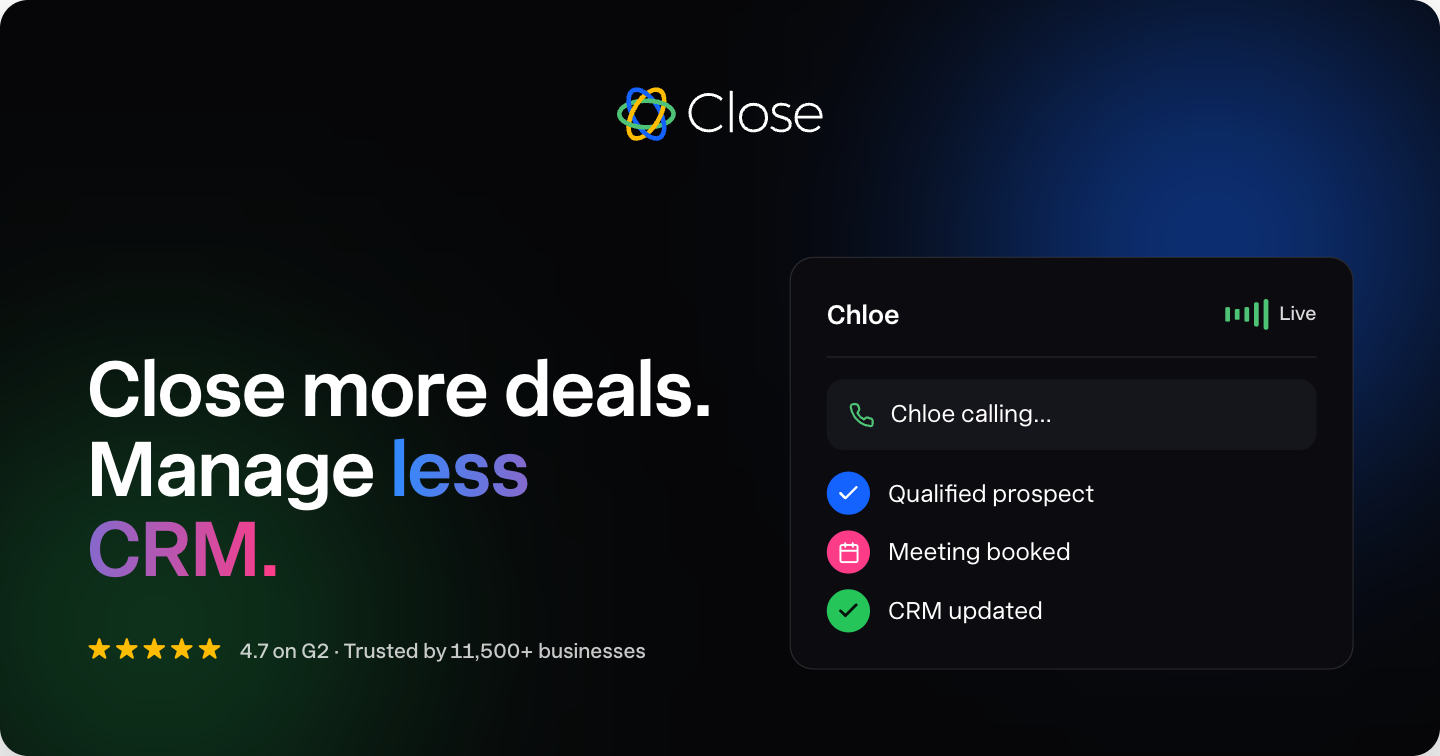
That distinction matters. Close is not simply a chatbot layered over a contact list. It is an operational CRM with lead records, pipelines, communication history, workflows, reporting, and sales automation. Chloe works inside that system to help qualify leads, conduct calls, capture information, book meetings, prepare follow-up, and update CRM records.
For a sales team, the promise is straightforward: spend less time maintaining the CRM and more time having the conversations that create revenue.
What Is Close CRM?
Close is a customer relationship management platform designed primarily for sales-focused businesses. It combines the system of record, where leads and opportunities live, with the communication and execution tools representatives use every day.
The platform brings together:
- Lead, contact, and opportunity management
- Visual sales pipelines and deal stages
- Built-in email, calling, and SMS
- Automated multi-step workflows
- Task creation and follow-up reminders
- Meeting scheduling and note capture
- Sales reporting and activity visibility
- AI-assisted summaries, qualification, and next actions
- Chloe, an AI sales teammate built directly into Close
This integrated approach is the central reason Close feels different from a traditional CRM. Many systems store customer information well but require several additional products to act on it. Close is designed to let a seller move from record to conversation without leaving the workspace.
If you want a deeper walkthrough after this overview, open the Close AI tool page.
Meet Chloe, the AI Sales Teammate Inside Close
Chloe is Close's native AI layer. According to Close, Chloe can call leads, run qualification conversations, handle common questions and objections, book meetings, and log the outcome in the CRM. She can also help enrich records, summarize activity, surface suggested actions, and answer questions about leads and deals using the data already stored in Close.
Because Chloe is built into the CRM, the handoff between AI and a human representative can include the context that normally gets lost between separate tools. A rep can see what was discussed, whether the lead qualified, what action was taken, and what should happen next.
A practical Chloe workflow might look like this:
- A new inbound lead enters Close.
- Chloe calls the lead based on the team's qualification criteria.
- The conversation is transcribed and summarized.
- Relevant fields and the deal stage are updated.
- A meeting is booked or a follow-up is prepared.
- The assigned representative receives the context needed for the next conversation.
This does not remove the need for a skilled salesperson. It targets the delay, repetitive administration, and inconsistent follow-up that often prevent skilled salespeople from reaching the right opportunities quickly.
The Core Close Workflow
Close is built around the idea that customer communication and CRM data should update one another.
Calling
Calling happens inside Close rather than through a disconnected dialer. Depending on plan and configuration, teams can use calling tools, capture recordings and transcripts, and generate AI-powered call summaries and action items. This is particularly useful for inside-sales teams where call volume and speed-to-lead matter.
Representatives can send individual and bulk email, reuse templates, automate follow-up, and use AI-assisted rewriting. Messages and replies remain attached to the lead record, giving the team one communication history instead of fragmented inbox knowledge.
SMS
Close supports one-to-one and automated SMS alongside email and calling. A workflow can combine channels rather than forcing every prospect through the same email-only sequence.
Workflows
Close Workflows can automate repeatable sales sequences using email, SMS, calls, task reminders, timing rules, and triggers. A team might build separate workflows for new inbound inquiries, demo follow-up, no-shows, dormant opportunities, or renewals.
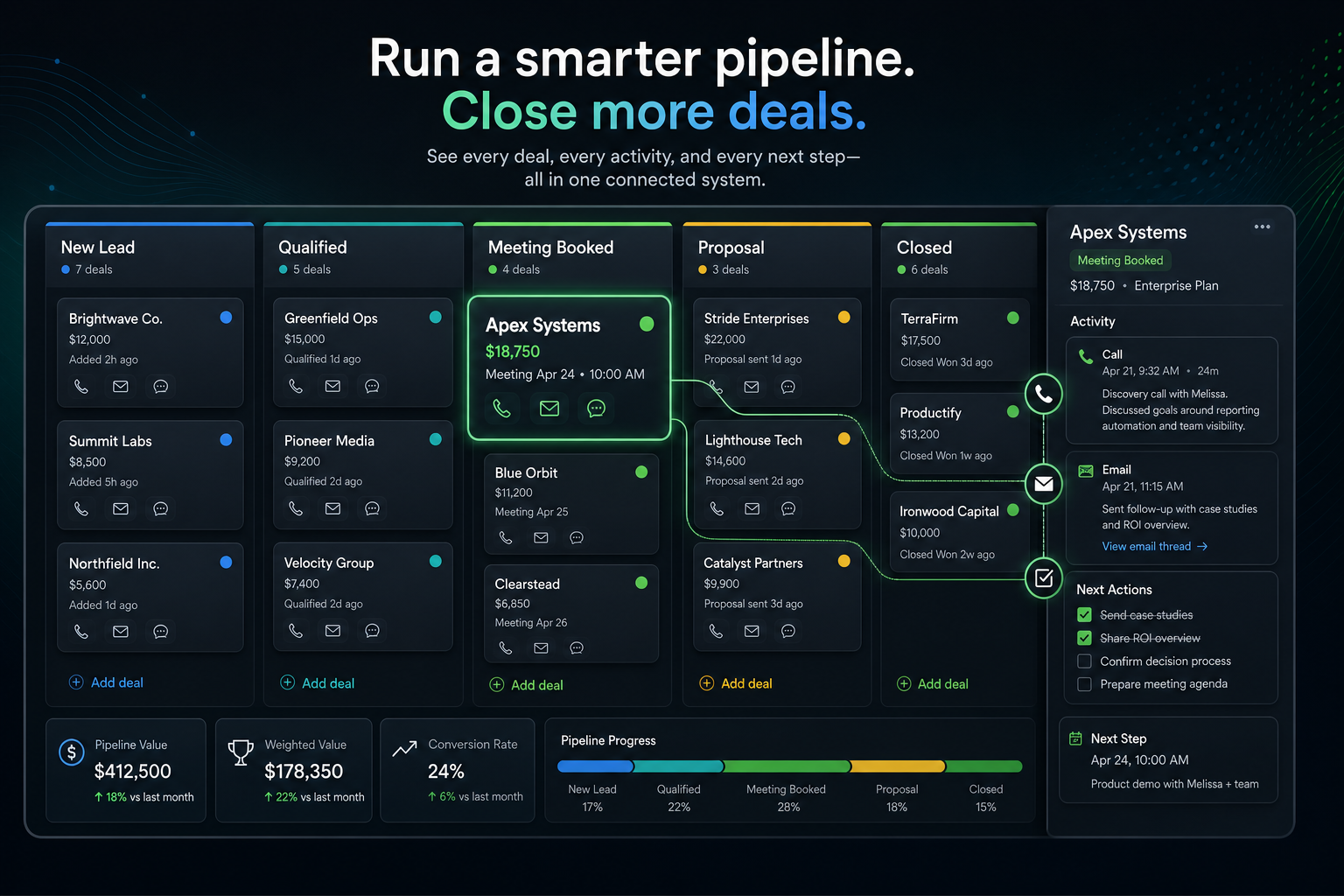
Pipeline Management
Lead details, activity, opportunities, statuses, and communication appear in the same system. Managers can see whether the pipeline is moving and representatives can identify the next action without reconstructing the history from several apps.
Who Is Close Best For?
Close is most compelling when selling is a high-frequency operational activity rather than an occasional back-office process.
Strong-fit customers include:
- Founder-led sales teams that need structure without a dedicated CRM administrator
- Startups and SaaS companies running inbound and outbound sales motions
- Agencies and consultancies that manage active prospect pipelines
- Inside-sales teams that rely heavily on calls, email, and SMS
- Small and midsize teams replacing a patchwork of CRM and outreach tools
- Teams that lose opportunities because follow-up is slow or inconsistent
The product is especially relevant when representatives spend too much time entering notes, switching tabs, scheduling reminders, or trying to determine who contacted a lead last.
Who May Need Something Else?
Close is deliberately sales-focused. That clarity is a strength, but it also defines the boundaries of the product.
A large enterprise with highly specialized governance, an extensive custom-object architecture, or a broad marketing, service, and commerce ecosystem may require a heavier platform. Likewise, a business that only needs a simple contact database may not use enough of Close's communication and automation features to justify the switch.
Before choosing any CRM, evaluate:
- The channels your team actually uses
- Required reporting and permission controls
- Existing integrations and data migration needs
- Expected calling and SMS usage costs
- How much AI usage the team expects
- Whether representatives will genuinely work inside the system
The best CRM is not the one with the longest feature list. It is the one your team keeps accurate because it supports the work they already need to do.
A Real-World Example: Speeding Up Inbound Sales
Imagine a software company collecting demo requests from its website. Without a coordinated system, a form submission may wait in an inbox, a representative may call hours later, and the notes may never make it back into the CRM.
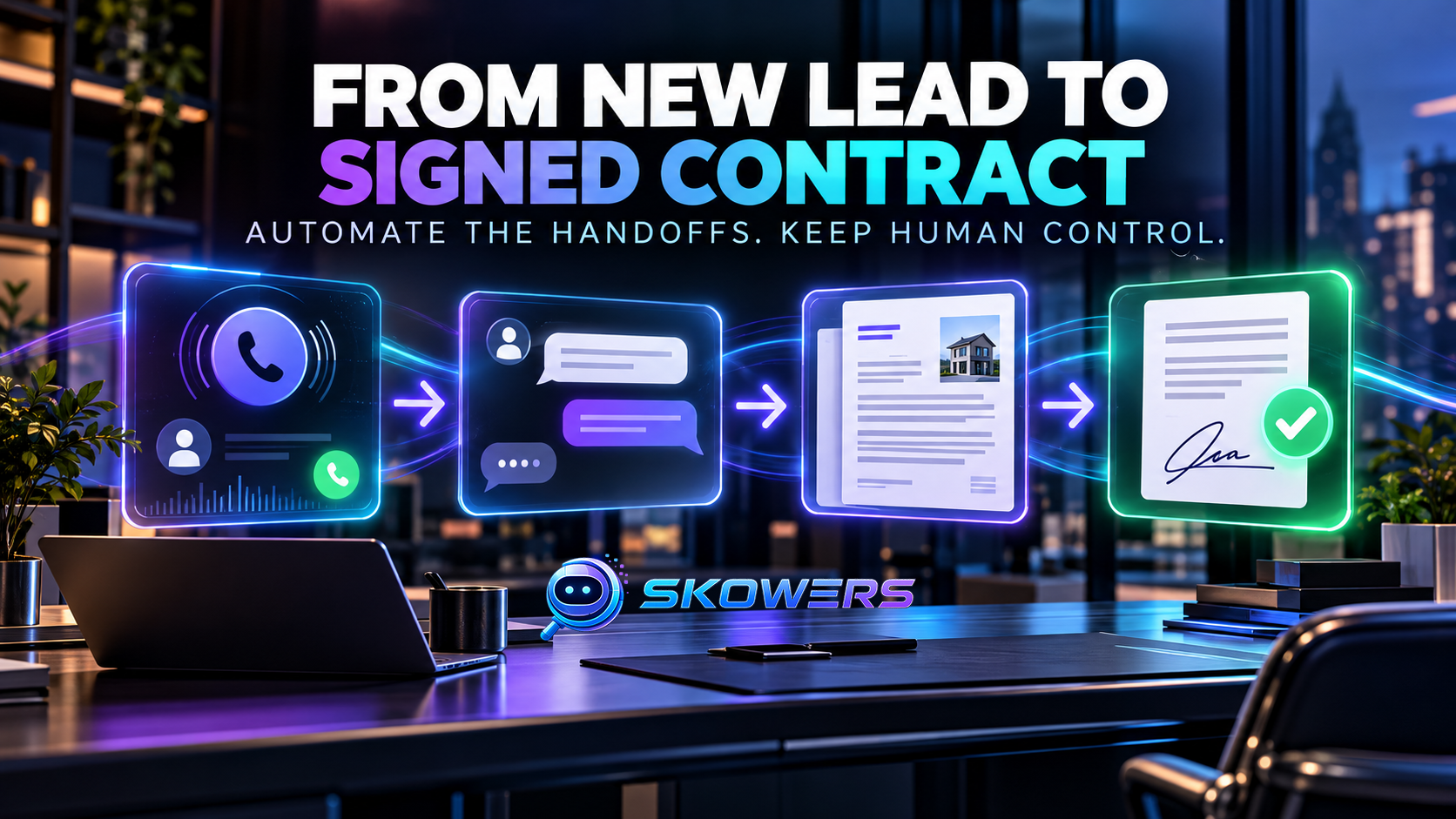
With Close, the team can route the new lead into a defined pipeline, trigger immediate activity, use Chloe to begin qualification, record the result, and hand a qualified meeting to a human seller. If the prospect does not answer, a workflow can continue with an email, SMS, or task at an appropriate interval.
The value is not automation for its own sake. It is a shorter gap between buyer intent and a useful response, plus a reliable record of what happened.
What We Would Test During a Close Trial
A useful CRM trial should involve real work, not a tour of every settings page. Import a small, representative set of leads and run one complete sales motion.
Use this evaluation plan:
- Connect the communication channels your team uses most.
- Create the actual pipeline stages used in your sales process.
- Build one workflow for a high-value scenario, such as demo follow-up.
- Test a call, email, SMS, and meeting handoff.
- Review how accurately activity, notes, and next steps are captured.
- Test Chloe against your real qualification criteria.
- Measure response time, administrative time, and follow-up completion.
At the end of the test, ask three questions:
- Did representatives complete more selling activity with less tab switching?
- Did the CRM record become more complete without extra manual work?
- Did leads receive faster and more consistent follow-up?
If the answer is yes, Close is solving an operational problem rather than merely adding another AI feature.
For a practical launch checklist, fast-win automations, suggested prompts, and trial scorecard, continue in the Close AI tool page.
Pricing and AI Usage
Close offers multiple plans for different team sizes and levels of automation. Its public pricing may change, and communication or AI usage can create additional costs depending on the selected features and volume. Chloe is available across Close plans, while AI features use credits or usage-based pricing.
Review the current plan details, included AI credits, phone and SMS charges, and any relevant add-ons before rollout. Model the total cost against the tools Close may replace, not only the CRM subscription in isolation.
The Bottom Line
Close is a sales-focused CRM for teams that want communication, pipeline management, automation, and AI execution in one place. Close CRM is the platform; Chloe is the built-in AI teammate that can help call and qualify leads, book meetings, capture conversations, update records, and keep follow-up moving.
Its strongest use case is a founder, startup, agency, or inside-sales team that actively sells through calls, email, and SMS and wants fewer gaps between those conversations and the CRM.
Close will not replace sales judgment, relationship building, or a well-defined offer. It can remove a meaningful amount of the coordination and administration surrounding those human strengths.
If your team has leads but struggles with response time, follow-up consistency, or CRM maintenance, start a Close trial through Skowers and test it on one real pipeline. By the end of a focused trial, you should know whether Close helps your team manage less CRM and close more of the right deals.
Want more detail before you decide? Read the Close AI tool page.

Related Articles


Continue Your Research