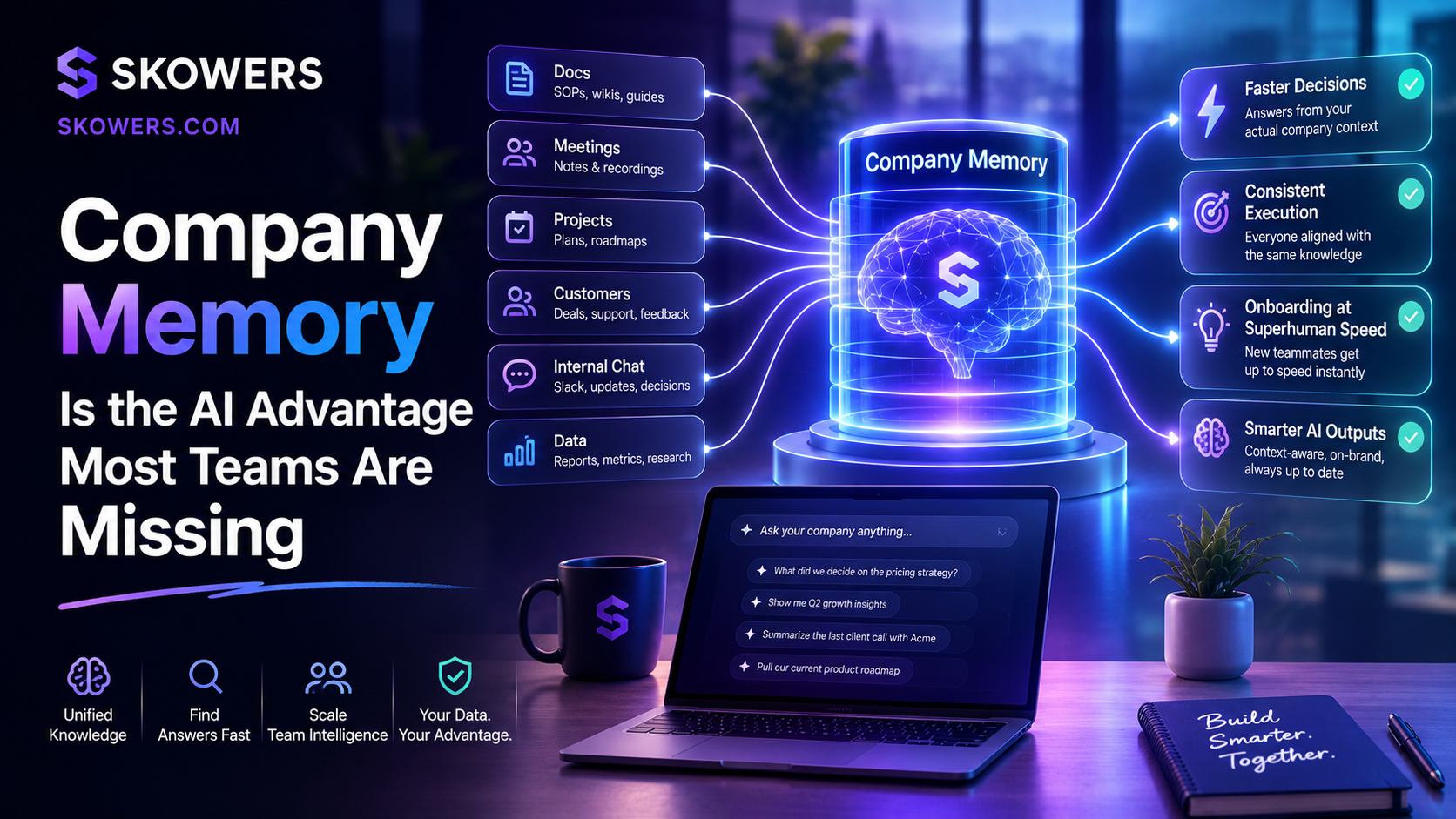
Company Memory Is the AI Advantage Most Teams Are Missing
Listen: Company Memory Is the AI Advantage Most Teams Are Missing
Most teams do not have an AI problem.
They have a memory problem.
The company knows things, but the knowledge is scattered. A pricing note lives in a slide deck. Customer objections live in call notes. Product decisions live in Slack. Support issues live in tickets. Sales promises live in a CRM. The newest positioning lives in a doc that only one person remembers.
Then the team opens an AI tool and expects useful answers.
Sometimes it works.
Often it guesses around the gaps.
That is why company memory is becoming one of the most important layers in the modern AI stack. The next wave of useful AI will not come only from smarter models. It will come from better context.
Why Company Memory Matters Now
AI is moving from personal chat into daily business work.
People are using it to plan launches, summarize customer feedback, prepare sales calls, draft support replies, analyze campaigns, write documentation, and make decisions faster. OpenAI has introduced company knowledge features that connect ChatGPT to work apps so answers can include business-specific context and citations. Google has also pushed enterprise search and agent systems that help employees find and act on information across company tools.
The pattern is clear.
AI is becoming more useful when it can see the right business context.
That does not mean every file should be thrown into one giant knowledge base. It means teams need a cleaner way to decide what information matters, where it lives, who can access it, and how it should be used.
Company memory is not a folder.
It is the operating layer that helps AI understand how your business actually works.
The Real Problem Is Fragmented Context
Most businesses already have plenty of information.
The problem is that the information is hard to retrieve at the exact moment someone needs it.
A marketer needs the latest customer proof before writing a landing page.
A salesperson needs recent support risks before calling an account.
A founder needs the latest revenue story before talking to an investor.
A support agent needs the actual refund policy before answering a frustrated customer.
A product manager needs the original decision record before changing a feature.
Without company memory, each person has to hunt across tools. They search email, Slack, Drive, Notion, CRM, tickets, analytics, and old decks. When that takes too long, they ask AI with incomplete context.
Incomplete context creates confident but shallow output.
That is the failure mode.
The AI sounds polished, but it does not know the business.
What Company Memory Should Include
Useful company memory starts with the information that shapes decisions.
It does not need every file on day one.
Start with the sources that people already ask about often.
- Customer promises and objections
- Product positioning and messaging
- Pricing rules and packaging notes
- Support policies and escalation paths
- Case studies and proof points
- Sales call notes and account history
- Internal operating procedures
- Brand voice and writing examples
- Product docs and onboarding steps
- Campaign results and lessons learned
The goal is not to collect information for its own sake.
The goal is to make the important context easy to find, cite, and apply.
If the memory layer cannot help someone make a better decision, it is probably noise.
The Difference Between Storage And Memory
Cloud storage keeps files.
Company memory keeps meaning.
That difference matters.
A folder can hold a hundred documents about customer onboarding. A memory layer should help answer what new customers struggle with, which steps cause the most delays, what the team already changed, and what should happen next.
A CRM can hold contact records. A memory layer should help explain the relationship, the account risk, the last objection, the promised follow-up, and the best next action.
A support desk can hold tickets. A memory layer should show patterns, not only conversations.
Storage is where information sits.
Memory is how the business recalls what matters.
What Good AI Memory Feels Like
Good AI memory does not feel magical.
It feels useful.
A good system can answer with context instead of vague advice. It can show where information came from. It can separate current facts from old assumptions. It can respect permissions. It can say when it does not know.
That last part matters.
The best business AI is not the one that always answers.
It is the one that knows when the available context is weak.
If the refund policy changed last month, the AI should not rely on an old onboarding deck. If a prospect has an open support issue, the AI should not write a cheerful upsell email without warning the seller. If a product claim has not been approved, the AI should not turn it into public copy.
Memory makes AI safer because it gives the system something real to work from.
The Buyer Questions To Ask
When comparing AI tools for company memory, buyers should ask practical questions.
- What sources can this tool connect to?
- Does it respect the permissions already set in those tools?
- Does it show citations or source links?
- Can users filter by date, project, account, or team?
- Can it tell the difference between draft notes and approved policies?
- Can admins control which data sources are available?
- Does it support private or sensitive knowledge safely?
- Can it help with action, or only search?
- Does it fit the tools the team already uses every day?
These questions matter more than a flashy demo.
A beautiful answer is not enough if the source is unclear.
Where Teams Should Start
The best starting point is one high-value workflow.
Do not try to organize the whole company at once.
Start with the workflow where missing context costs time, money, or trust.
For a sales team, that might be account briefing before calls.
For a support team, it might be approved answers for common issues.
For a founder, it might be investor updates that pull from revenue, product, and customer feedback.
For a marketing team, it might be turning real customer proof into sharper landing pages.
For an operations team, it might be standard procedures that new employees can search and follow.
Pick one workflow, connect only the sources it needs, and test whether the answers are actually better.
That is enough to learn.
The Human Review Layer
Company memory does not remove human judgment.
It gives judgment better inputs.
Someone still needs to decide which documents are trusted, which policies are current, which sources are sensitive, and which outputs require review. Without that discipline, company memory can become a faster way to spread confusion.
Human review is especially important for:
- Legal language
- Pricing commitments
- Medical or financial claims
- Hiring notes
- Customer refunds
- Security issues
- Public statements
- Enterprise account strategy
AI can gather and draft.
People still own the decision.
That is not a weakness. It is the operating model.
The Cleanest Stack Wins
The strongest AI stack is not always the stack with the most tools.
It is the stack with the cleanest handoffs.
If your CRM is the source of customer truth, keep it clean. If your docs hold approved policies, name them clearly. If support tickets show real product pain, make those insights visible to the teams that need them. If Slack contains decisions, capture the final answer somewhere durable.
AI should not be forced to guess from scattered fragments.
Give it better inputs.
The reward is compounding.
Every better note, cleaner policy, clearer customer record, and stronger decision log makes the next AI workflow more useful.
A Simple Company Memory Checklist
Use this checklist before trusting AI with business context.
- Are the important sources connected?
- Are old or outdated documents clearly separated?
- Are permissions respected?
- Are citations visible?
- Is there one approved source for key policies?
- Are customer facts tied to the right account?
- Are public claims backed by proof?
- Can users tell when an answer is uncertain?
- Is human approval required for sensitive work?
- Does the workflow save time without hiding risk?
If those basics are missing, slow down.
The AI may still be helpful for drafts, but it is not ready to act like company memory.
The Bottom Line
Company memory is becoming the practical foundation for useful AI at work.
The model matters, but context decides whether the answer fits the business.
Teams that organize their knowledge will get better sales prep, better support answers, better marketing, better onboarding, and better decisions from the same AI tools.
Teams that ignore memory will keep getting polished guesses.
The advantage is not only having AI.
The advantage is giving AI enough trusted context to help.

Related Articles
Continue Your Research