
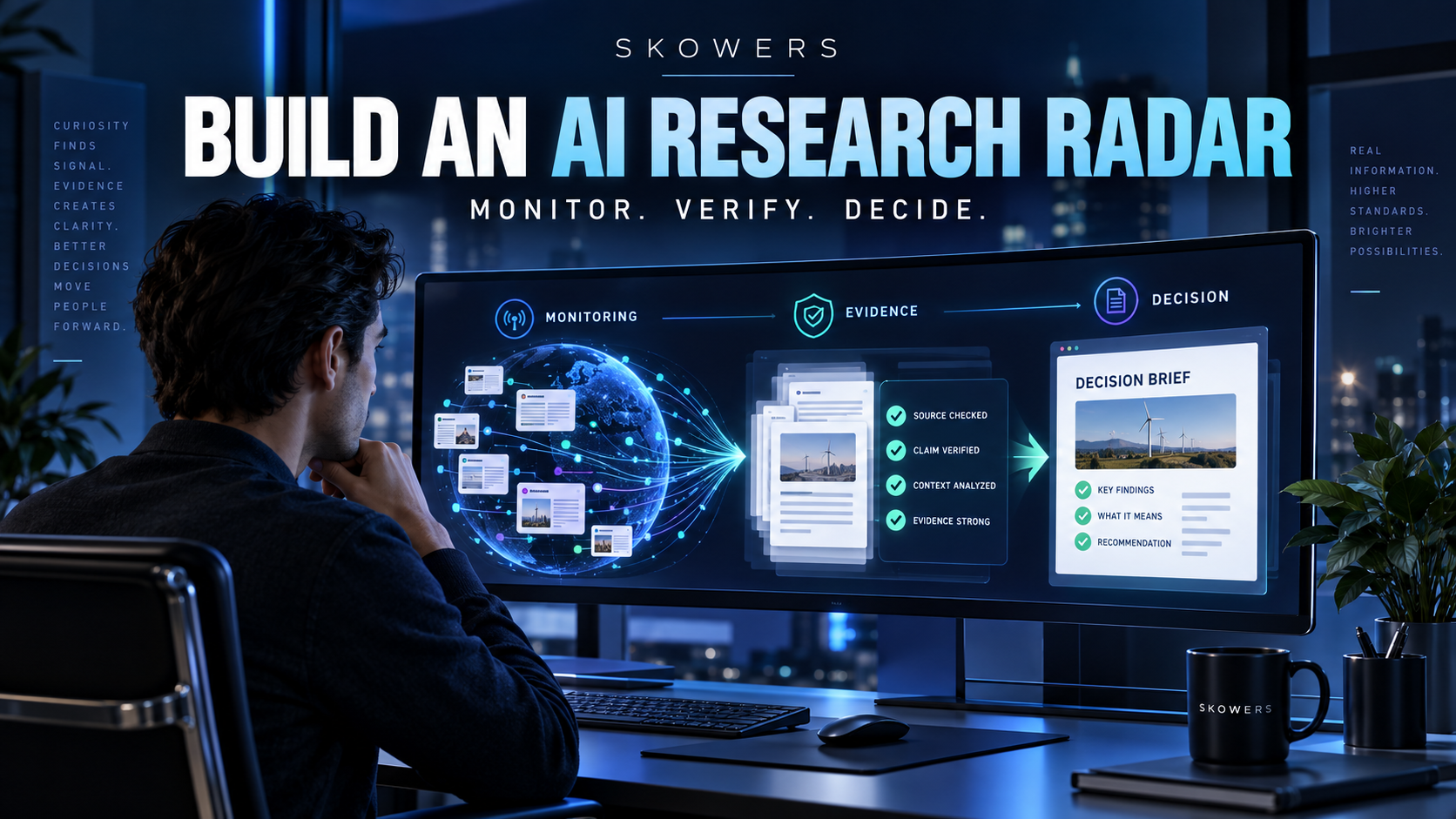
Build an AI Research Radar: How to Monitor Changes, Verify Claims, and Make Better Decisions
The internet can tell you what changed. It cannot automatically tell you what matters.
That distinction is becoming more important as teams use AI to watch competitors, summarize research, track customer questions, and follow how brands appear in AI search. A monitoring tool can collect hundreds of changes. A research assistant can summarize dozens of papers. An AI visibility platform can surface new mentions. None of those signals becomes useful until someone connects it to a decision.
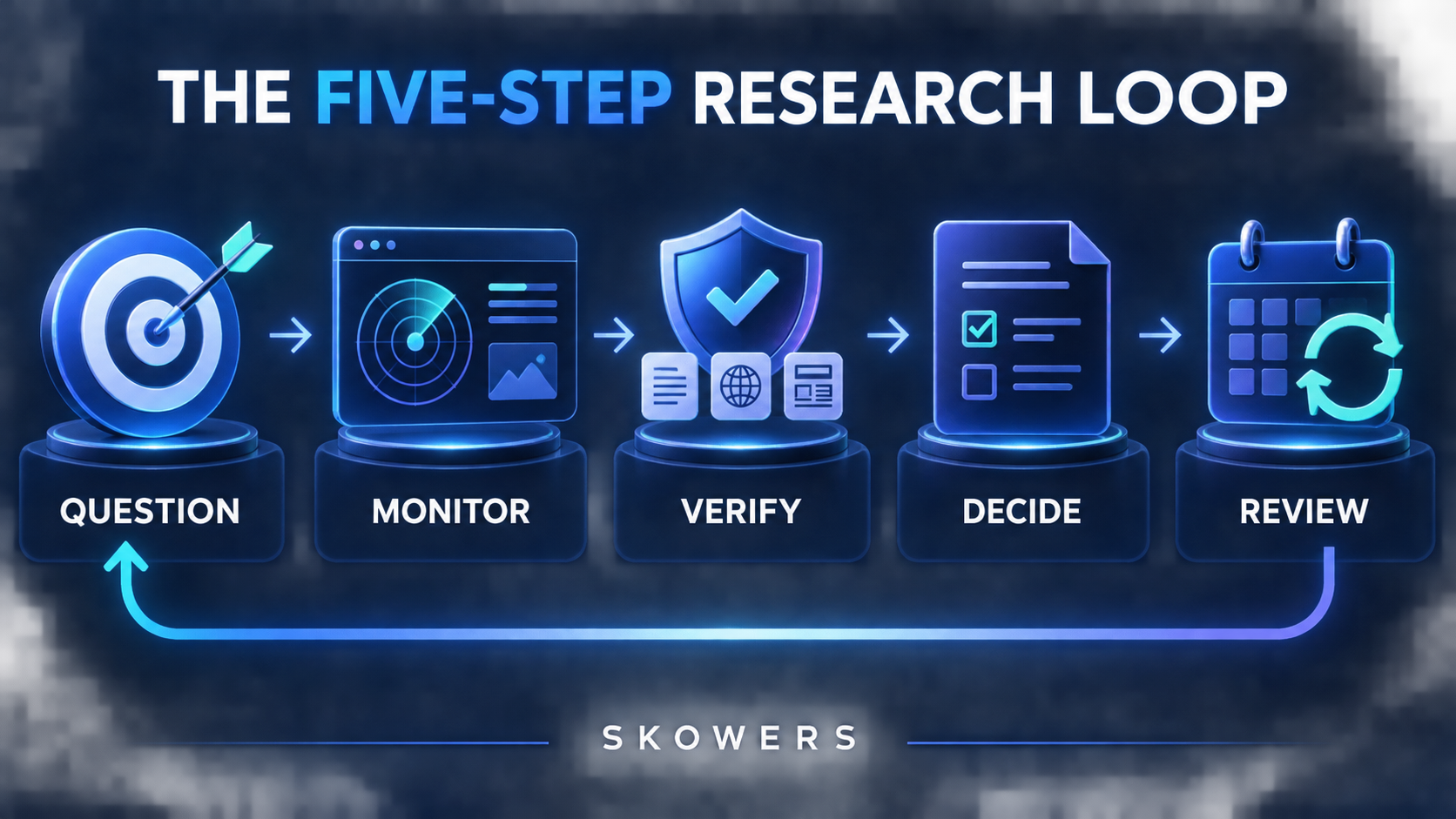
This guide shows how to build an AI research radar that does five things well: asks a focused question, monitors the right sources, verifies important claims, creates a decision brief, and reviews the system on a schedule.
It is designed for founders, marketers, product teams, consultants, and small businesses that need current information without spending every morning checking tabs.
Last reviewed September 25, 2026. Product features and pricing can change. Confirm current details before choosing a plan.
Skowers may earn a commission from partner links in this article at no additional cost to you. Recommendations are based on the job each tool can perform in the workflow, not on commission alone.
What Is an AI Research Radar?
An AI research radar is a repeatable system for noticing meaningful changes before they become urgent.
It is not a giant feed of everything happening in your industry. It is a small set of monitored questions, trusted sources, evidence rules, and decision triggers.
A useful radar might answer questions such as:
- Did a competitor change pricing, positioning, or its free trial?
- Are customers asking about a problem we do not explain well?
- Has credible research changed what we should claim in our content?
- Are AI answer engines recommending our business for the prompts that matter?
- Did a regulation, platform policy, or technical standard change?
The value comes from choosing the question first. Monitoring without a question creates an inbox. Monitoring with a question creates intelligence.
The Five-Step Research Loop
1. Start With a Decision, Not a Topic
“Track AI news” is too broad. “Tell me when a major AI app builder changes its entry price, export policy, or usage limits” is actionable.
Write down the decision that a new signal could change. If no realistic decision follows, the topic probably does not need continuous monitoring.
Decision we may need to make:
Question we need current information to answer:
Sources we trust first:
Changes worth alerting us about:
Evidence required before we act:
Who reviews the alert:
Possible actions:
Review schedule:
This short brief protects the system from expanding into endless research. It also gives an AI assistant a clearer job than “keep me updated.”
2. Monitor a Small Source Set
Choose sources close to the event. For product changes, start with official pricing pages, changelogs, documentation, and status pages. For market movement, add selected competitor pages, customer reviews, job postings, and reputable trade publications. For scientific or health claims, use primary research and systematic reviews.
Browse AI can turn selected webpages into structured monitors without requiring custom scraping code. Its role in this system is collection. You can watch a pricing table, feature page, directory, or other permitted public source and schedule checks for changes.
Use monitoring responsibly. Respect site terms, access controls, privacy, copyright, and applicable law. Do not collect personal data simply because it is visible. Do not bypass logins or technical restrictions. Store only the information needed for the stated business question.
Start with three to five sources. A smaller monitored set is easier to audit and less likely to bury an important change under routine noise.
3. Verify Before You Summarize
An alert is not evidence. A changed sentence may be a typo, an experiment, a regional variation, or a page update unrelated to your decision.
For each important signal, ask:
- Is this the original source?
- Is the information current and dated?
- Can a second independent source confirm it?
- Does the source actually support the claim being made?
- What remains unknown?
When a decision depends on scientific evidence, Consensus can help search peer-reviewed research and expose the papers behind a summary. Its role is not to make every claim true. Its value is helping a non-specialist find relevant studies, inspect citations, and compare evidence faster.
Read beyond the summary for consequential decisions. Check study design, sample size, population, publication date, conflicts, limitations, and whether the result has been replicated. One paper can be interesting without being decisive.
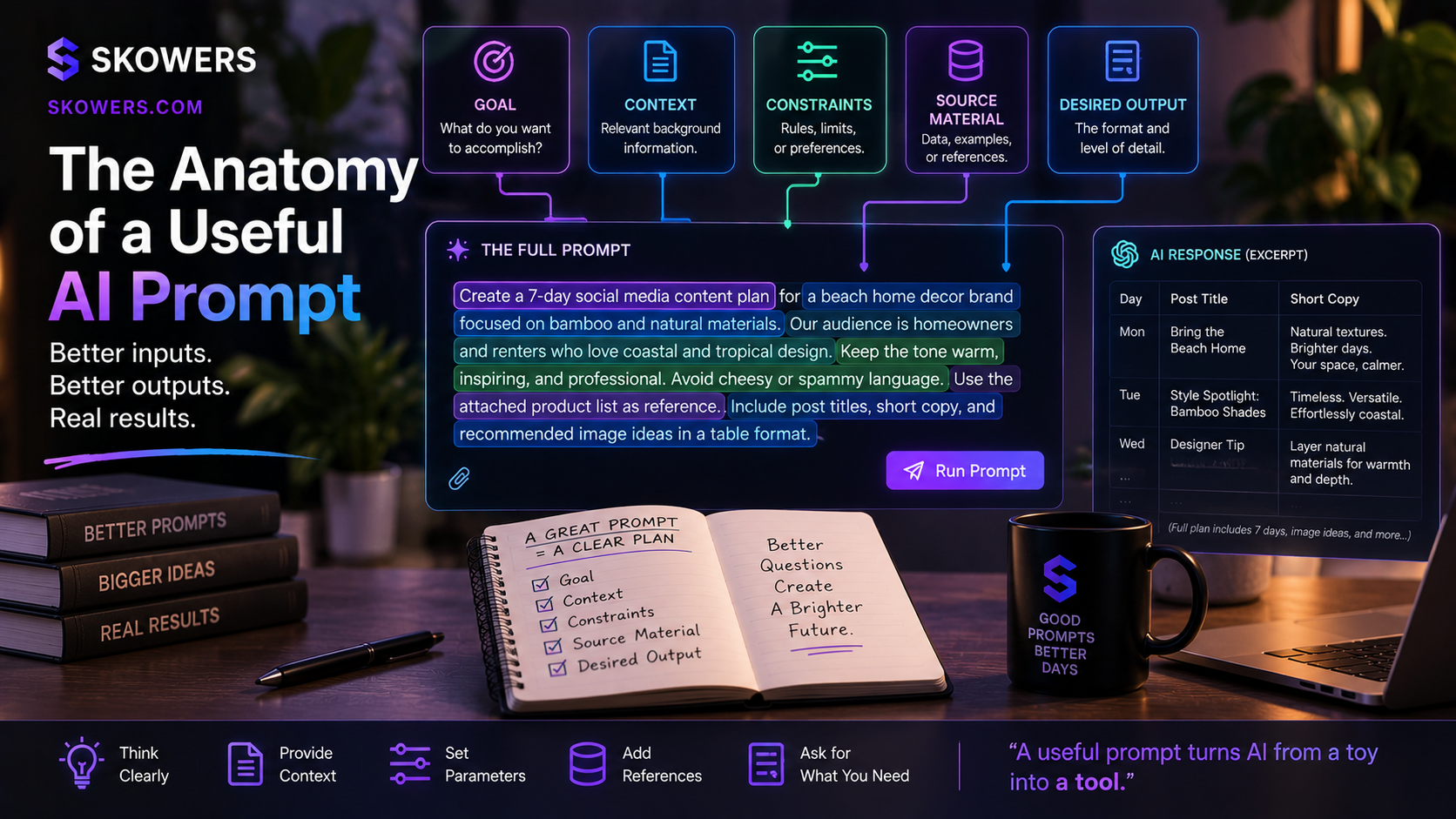
Evaluate this claim using only the sources I provide.
Claim: [PASTE CLAIM] Sources: [PASTE LINKS, EXCERPTS, OR CITATIONS]
Return: 1. What each source directly supports 2. What is inference rather than established fact 3. Any conflicts between sources 4. Missing context or evidence 5. A confidence level with a brief reason 6. The safest accurate wording for a decision brief
Do not fill gaps with assumptions. If the evidence is insufficient, say so clearly.
4. Convert Findings Into a Decision Brief
The output of research should not be a pile of links. It should be a short document that helps someone decide what to do.
Use this structure:
- What changed: One factual sentence with date and source.
- Why it matters: The connection to a customer, cost, risk, or opportunity.
- Confidence: High, medium, or low, with the reason.
- Recommended action: Act, test, monitor, or ignore.
- Owner and deadline: One person and one review date.
- Evidence: Direct links to the supporting sources.
Separate facts from interpretation. “Competitor X removed monthly pricing from its public page” is an observation. “Competitor X is abandoning small customers” is an inference. The brief should never present the second sentence as if the first one proves it.
Create a concise decision brief from the verified information below.
Decision question: [QUESTION] Verified facts: [FACTS WITH SOURCES] Uncertainties: [WHAT IS STILL UNKNOWN] Constraints: [BUDGET, TIME, POLICY, OR RISK]
Use these sections: - What changed - Why it matters - Evidence and confidence - Options - Recommended next step - Owner and review date
Label facts, interpretation, and recommendation separately. Keep the brief under 500 words.
5. Review the Radar Itself
Research systems become noisy over time. Pages change structure. Alerts stop being useful. Teams keep tracking questions that no longer affect a decision.
Review the radar monthly and ask:
- Which alerts led to a useful action?
- Which sources produced noise or duplicate information?
- Did any monitor fail silently?
- Were important claims verified before publication or action?
- Which decision questions should be added, narrowed, or retired?
The goal is not maximum coverage. It is dependable attention.
A Practical Three-Tool Stack
These tools address different parts of the system. They are examples, not requirements, and they should not be treated as interchangeable.
Browse AI for Web Monitoring
Use Browse AI when the information you need lives on selected webpages and changes over time. Good uses include permitted monitoring of pricing, product listings, public directories, feature pages, and market data.
Best first test: monitor one public page for one field that directly affects a decision. Verify the captured result manually before expanding.
Consensus for Evidence Checks
Use Consensus when a claim depends on peer-reviewed research. It can shorten the path from a question to relevant studies, but a summary still needs source review.
Best first test: choose one claim already used in your content or product strategy. Find the strongest supporting and contradicting evidence, then rewrite the claim to match what the research actually establishes.
OmniSEO for AI Visibility Signals
Use OmniSEO when the decision concerns how a brand appears across AI search and answer experiences. It is designed to track prompts, mentions, citations, and competitive visibility so teams can see where their pages are or are not being referenced.
Best first test: choose a small group of buyer questions that matter commercially. Track whether your business appears, which sources are cited, and what useful information competing pages provide that yours does not.
Do not respond by manufacturing mentions or publishing thin pages. Improve the underlying evidence, clarity, product information, and usefulness of your site.
Three Research Radars You Can Build This Week
Competitive Change Radar
Monitor official pricing, product, integration, and changelog pages. Alert only when a change affects positioning, customer objections, packaging, or a planned feature. Produce a weekly brief rather than sending every raw change to the team.
Evidence Radar
Choose a narrow question tied to product claims, content, or customer education. Review new evidence on a monthly or quarterly cadence. Record what changed, what did not, and whether public wording needs revision.
AI Visibility Radar
Track a focused set of real buyer questions. Record which brands and sources appear, whether the answer is accurate, and what content gaps repeatedly surface. Use the findings to improve useful pages, not to chase every prompt variation.
What Should Stay Human?
AI can collect, organize, compare, and draft. A person should own decisions that affect money, customers, reputation, employment, safety, privacy, or public claims.
Keep human approval around:
- Publishing claims based on research
- Changing prices or product strategy
- Contacting people identified through collected data
- Acting on legal, medical, financial, or security information
- Removing a source from the trusted set
- Changing the confidence assigned to a finding
Automation should reduce repetitive checking. It should not hide uncertainty.
Common Mistakes
Monitoring Everything
More sources create more maintenance and more false urgency. Start with the smallest set that can answer the decision question.
Treating a Summary as a Source
An AI summary is an interpretation. Keep the original link, date, excerpt, and source identity attached to the finding.
Automating the Decision
Alerts can recommend a next step. They should not automatically change a public claim, customer promise, or business strategy without review.
Ignoring Negative Evidence
A useful radar searches for information that could disprove the preferred answer. Ask what evidence would change your mind before research begins.
Forgetting the Time Dimension
A true statement can become outdated. Add a checked date and a review date to important findings.
How to Measure Whether the System Works
Track outcomes rather than alert volume.
Useful measures include:
- Time from meaningful change to team awareness
- Percentage of alerts that led to a decision or test
- Number of claims corrected before publication
- Research hours saved without lowering source quality
- Decisions revisited because new evidence appeared
- Monitors retired because they produced no value
If the number of alerts rises while decisions do not improve, the radar needs a narrower question.
Frequently Asked Questions
Can AI do market research automatically?
AI can automate parts of collection, organization, and summarization. Defining the question, evaluating source quality, interpreting uncertainty, and choosing an action still require accountable human judgment.
Is web monitoring the same as web scraping?
Monitoring repeatedly checks selected information for changes. Scraping extracts information from webpages. A monitoring workflow may use extraction, but the purpose, schedule, scope, and compliance requirements matter.
How many sources should a small business monitor?
Start with three to five high-value primary sources for one decision question. Add sources only when they fill a demonstrated gap.
Can AI verify whether a claim is true?
AI can help locate evidence and compare sources. It can also misunderstand evidence or overstate confidence. Important claims require inspection of the underlying sources and appropriate expert review.
How often should the radar run?
Match the schedule to the cost of delay. Daily monitoring may make sense for pricing or availability. Monthly review may be enough for research evidence or positioning. Faster is not automatically better.
Helpful Next Steps on Skowers
Use the Prompt Library to create clearer research and verification requests. Browse Automation Templates when you are ready to connect an alert to a reviewed workflow. Read AI-Ready Data Is Becoming the New Competitive Advantage to improve the information your AI system receives, and AI Receipts Are Becoming the Trust Layer for Digital Work to build a clearer record of sources, approvals, and decisions.
The Bottom Line
The advantage is not seeing more information. It is noticing the right change, checking whether it is real, and connecting it to a responsible action.
Build the radar around one decision. Monitor a small source set. Preserve original evidence. Label uncertainty. Let AI handle repetitive collection and first-pass organization, then keep a person responsible for the conclusion.
That is how research becomes a business system instead of another feed to ignore.
Related Articles
Continue Your Research